
“My French acte de mariage had three marginal notes recording a name correction and a régime matrimonial change. CertTranslate translated every note and the attorney said it was exactly what USCIS needed for the I-130.”
S
Sophie M.
New York, NY
Acte de mariageCopie intégraleExtrait d’acte de mariage
Certified English translation for USCIS, spouse petitions, courts, legal name changes, and consular use.
Ready within 24 hours
Complete translation
Word-for-word, same structure
Every field, stamp, seal, signature, and annotation
Certified package
Signed and Stamped Certificate of Accuracy
Company letterhead · translator signature · company stamp

We check your files and confirm the total before you pay




French marriage certificate translation produces a certified English version of acte de mariage, livret de famille, and other French-language marriage records from France, Haiti, Cameroon, Senegal, Quebec, and other Francophone jurisdictions, formatted for USCIS spouse petitions, courts, and civil-status filings.
Most clients order this service for Form I-130 (spouse petition) or Form I-485 (adjustment of status) filings with USCIS, where the marriage certificate proves the legal relationship that anchors the case. Form N-400 (naturalization) packets also commonly require a translated marriage certificate when marital status is relevant to the application.
The same translation is needed for state courts, benefits agencies, and insurance providers that require certified English proof of a French-language marriage. In every case, marginal notes, witness fields, and registrar notations must be preserved exactly as they appear on the original record.
For French marriage certificate translation, we translate every marginal note, livret de famille entry, and registrar notation so the English version is a complete reproduction of the original civil-registry record.
PDF, photo, or scan — any format works. Takes about 30 seconds.

A native-speaking French translator handles every word, stamp, and signature. Signed Certificate of Accuracy included — USCIS-ready format.
Review the completed translation before it is certified — unlimited free revisions until every detail is right. Final searchable PDF delivered typically within 24 hours.
4.9/5•From 2,400+ reviews
“My French acte de mariage had three marginal notes recording a name correction and a régime matrimonial change. CertTranslate translated every note and the attorney said it was exactly what USCIS needed for the I-130.”
Sophie M.
New York, NY
“My Haitian marriage record was partly handwritten and another translator skipped some annotations. CertTranslate handled the full document and matched the names to my passport for the spouse petition.”
Pierre-Louis H.
Miami, FL
“I submitted my livret de famille instead of a standalone marriage certificate. They translated the marriage section and the relevant birth entries, and the filing went through without any issues.”
Amélie C.
San Francisco, CA
We don't have a published case on French marriage certificate translation specifically — here are recent French translation cases on related documents.

A French driving license (permis de conduire) carried most of its content as non-text elements — vehicle-category icons, a photo, security stamps, and a machine-readable zone. A plain word-for-word translation would have dropped that meaning. We described each non-text element in brackets, translated the text inside the stamps, and reproduced the machine-readable zone exactly. The certified translation was delivered for the client's USCIS filing.
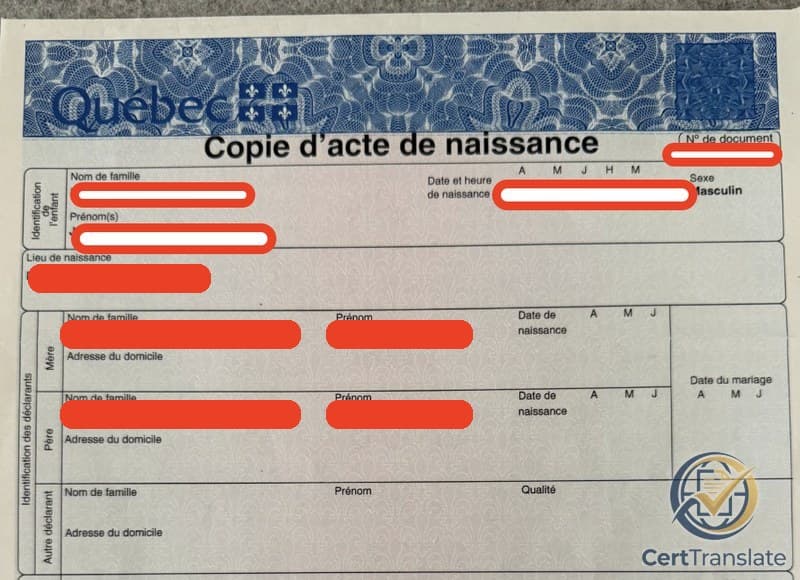
A Quebec long-form Copie d'acte de naissance used the DEC convention '(S)' after two typed names — the father and the signing registrar — to mark the original act as signed without reproducing the signature, and 'p. i.' after the registrar's title for par intérim (acting). We preserved each '(S)' verbatim, rendered 'p. i.' as 'acting,' and kept the document-type label as 'Copy of an act of birth.' The certified translation was delivered for the client's USCIS filing.
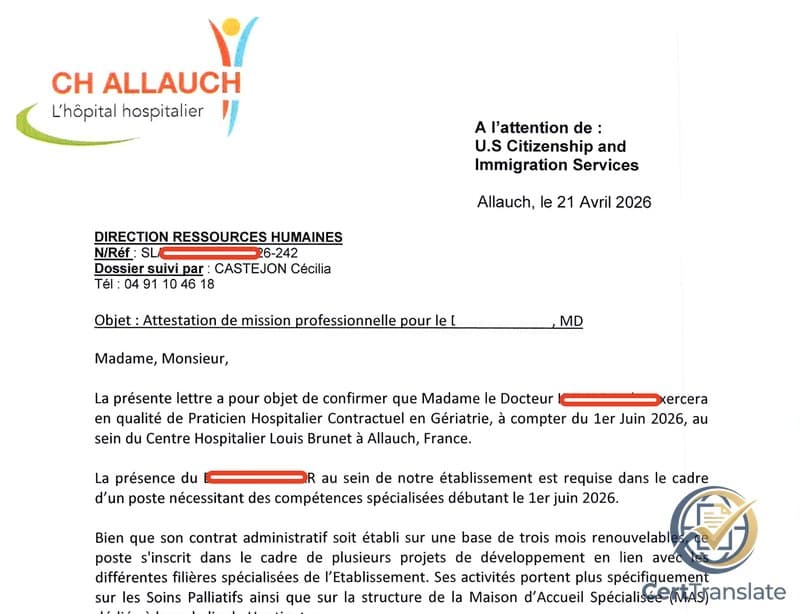
A French hospital sent an employer attestation to USCIS for a physician's immigration filing. The signature page carried an institutional stamp written entirely in French, overlapping the handwritten signature. Because every text element of a foreign document — including stamps — must be fully translated for USCIS, we rendered every line inside the stamp into English: institution name, signatory's title, and phone number. The certified translation was delivered with no source-language text remaining.
French marriage certificate translation requires handling civil-registry formatting that varies across Francophone countries, marginal notes (mentions marginales) that carry legal updates recorded after the marriage, livret de famille booklets that bundle multiple civil events into one document, and bilingual records from North and West Africa — challenges that sit at the intersection of French language expertise and marriage-certificate document knowledge.
A French metropolitan acte de mariage, a Haitian marriage record, a Cameroonian certificat de mariage, and a Quebec acte de mariage may all prove the same legal event but differ in civil-registry formatting, marginal-note conventions, and institutional language enough that the translation has to reflect the exact issuing system.
Your marriage certificate is translated by a native French speaker who handles civil-registry records daily, so acte de mariage formatting, livret de famille structure, marginal notes (mentions marginales), and name conventions across Francophone civil-law systems are reviewed with filing-level accuracy rather than guessed.
If USCIS or any receiving authority asks for a translation-only correction, we revise the file at no extra cost so the English version stays aligned with the original record and the rest of the filing packet.
French civil-registry marriage records often include mentions marginales — marginal notes added after the original event to record subsequent events such as divorce, separation, adoption, nationality changes, or name corrections. These notes are part of the legal record and must be translated as part of the certified package.
A translator who skips marginal notes or treats them as footnotes creates an incomplete translation. We translate every mention marginale on the record because a receiving officer may cite a missing note as grounds for a request for evidence.
The livret de famille is a French civil-registry booklet that records marriages, births of children, divorces, and deaths for a single family unit. Some USCIS applicants submit the livret de famille as their marriage evidence rather than a standalone acte de mariage.
We translate the marriage section and any related entries — births, amendments, annotations — that the applicant or attorney marks as relevant. When the reviewing authority needs only the marriage evidence, we identify the relevant pages clearly so the translation is complete but not padded with unneeded sections.
France, Haiti, Cameroon, Senegal, and Quebec all use civil-law registration systems inherited from French administrative tradition, but each jurisdiction has adapted the format, institutional terminology, and record structure differently. A French metropolitan acte de mariage reads differently from a Haitian marriage extract or a Cameroonian certificat de mariage.
The translator has to recognize and render these country-specific differences accurately in English rather than applying a generic French-marriage-certificate template to every record. Institutional labels, registrar titles, and statutory references all vary by jurisdiction.
Some French-language marriage records from North Africa (Morocco, Algeria, Tunisia) or West Africa include both French and Arabic or a local language on the same document. The two language sides may not be identical — one may contain annotations, stamps, or corrections that the other does not.
When a marriage certificate includes multiple languages, we translate all French-language content and flag any material differences visible between the language sections. This ensures the English translation covers everything a reviewing officer might reference on the original.
These marriage records share French as the document language, but the civil-registry structure, marginal-note conventions, and institutional formatting change by issuing country.
French metropolitan marriage certificates (acte de mariage) are issued by the mairie and follow a standardized civil-registry format. They typically include the spouses’ full names, dates and places of birth, witnesses’ names, and the registrar’s signature. Marginal notes may record subsequent divorces, nationality changes, or régime matrimonial elections.
These records commonly appear in I-130 (spouse petition), I-485 (adjustment of status), and N-400 (naturalization) filings. France is a Hague Apostille Convention member. We preserve every field, including mentions marginales, registrar notations, and the régime matrimonial clause, so the English version matches the original exactly.
Haitian marriage records may follow the French civil-registry model but with local institutional language, registrar titles, and formatting conventions that reflect the Haitian legal system. Older records may be handwritten and scanned at lower quality.
Haiti is a significant source of USCIS marriage-certificate translations. We handle the full document, including witnesses, registrar notations, and any stamps or annotations. When the scan quality is borderline, we review the image before beginning and request a better scan if critical fields are unreadable.
Cameroonian marriage certificates may be issued in French, English, or bilingually, depending on the region. French-language certificates follow a civil-registry model adapted to Cameroonian institutional terminology. Some records include local administrative references or stamps from regional offices.
We translate the French-language content and flag any bilingual elements. Cameroon is not in the Hague Apostille Convention for all purposes, so clients using these records outside USCIS should confirm legalization requirements separately.
Senegalese marriage records use French civil-registry conventions with institutional terminology and registrar titles that reflect the Senegalese legal system. Some records may include Wolof or other local language elements alongside French.
We translate all French-language content and preserve institutional references and registrar notations as printed, so the English translation is traceable to the original Senegalese record.
Quebec marriage certificates are issued in French by the Directeur de l’état civil and follow a format specific to the Quebec civil-law system. The institutional language and registrar conventions differ from French metropolitan records.
Canada is a Hague Apostille Convention member. We preserve the Quebec-specific formatting and institutional references so the English version reflects the actual issuing system rather than a generic French-marriage-certificate template.
$24.95
per page · no word cap
Typical length
Most actes de mariage are 1 to 2 pages
Typical total
$24.95
No hidden fees. Free Quote.
French marriage certificate translation costs $24.95 per page. Most clients pay between $24.95 and $49.90 because the typical acte de mariage is one or two pages. Livret de famille booklets may run higher depending on how many sections need translation. You receive the confirmed page count before payment, and there is no language surcharge for french.
Most marriage certificate orders are delivered within 24 hours once we receive clear scans. Annotation-heavy records or scans with faint stamps may take additional review time, but we confirm the delivery window before production starts.
Yes. This service is built for USCIS spouse petitions, court submissions, and other receiving authorities that need a complete certified English translation of a French marriage record, including witnesses, marginal notes, and registrar notations. Our package includes the full English translation plus a signed Certificate of Accuracy, which is the format most receiving authorities expect for foreign-language records.
Yes. We handle marriage certificates from France, Haiti, Cameroon, Senegal, Quebec, and other Francophone jurisdictions, with the translation matched to the exact issuing-country format and civil-law conventions. If your record uses a rare regional format, upload every page so the translator can match the exact issuing-country structure before production starts.
We can usually translate records with handwriting, stamps, and marginal notes if the scan is usable. If a critical note or seal is too faint to read safely, we ask for a better image before we certify the file. When a field is genuinely unreadable, we mark it transparently instead of guessing, which is safer than inventing a name, date, or registry number.
Yes — you receive the completed translation for review before we certify it, and we make unlimited free revisions until every name, date, and detail is right. If USCIS later requests a change, we correct the certified file at no charge.
No — we bill the physical page you upload, never a word count. Many services cap a "page" at 250 words and re-bill a dense marriage certificate as two or three pages; here one page of your document is one $24.95 page, however dense the text.
Yes. When the applicant submits a livret de famille instead of a standalone acte de mariage, we translate the marriage section and any related entries that the applicant or attorney identifies as relevant to the filing. We clearly label which pages correspond to the marriage evidence so the reviewing authority can evaluate the record without confusion.
Yes — marginal notes (mentions marginales) are legally binding updates to the civil-registry record and must be translated as part of the certified package. They may record divorces, nationality changes, name corrections, or other events that occurred after the original marriage. Omitting them creates an incomplete translation that may trigger a request for evidence.
A French acte de mariage records later legal events — divorce, name changes, régime elections — as mentions marginales in the margin. We translate every one, since a copie intégrale’s marginal notes are exactly what a USCIS officer checks.
| Field | What it is | How we handle it |
|---|---|---|
| Acte de mariage (extrait / copie intégrale) | The certificate type — extract vs full copy (copie intégrale shows marginal notes) | Type identified; we note when only an extract was provided. |
| Mairie / officier d’état civil + nº d’acte | Issuing town hall, registrar, and the act number | Authority and act number preserved exactly as printed. |
| Époux et épouse (noms complets) | Both spouses, full names | Names preserved and reconciled with passport/birth records in the packet. |
| Date et lieu du mariage / témoins | Date and place of marriage and the witnesses | Translated precisely; witnesses kept visible, not trimmed. |
| Régime matrimonial | Matrimonial property regime elected by the spouses | Clause translated; legal meaning preserved, not flattened. |
| Mentions marginales | Marginal notes added later — divorce, separation, name correction, nationality | Every marginal note translated — the field that shows whether the marriage still stands. |
A livret de famille booklet bundles marriage, births, and other events — we translate the marriage section and any entries marked relevant. Some North/West African records are bilingual (French + Arabic); we translate all French content and flag material differences between the language sides.
Most translation-related RFEs trace back to a few issues. These are what we check on every French-language marriage record.
01Mentions marginales skipped
We translate every marginal note, since a later divorce or name change is recorded there and an officer may cite a missing one.
02An extract submitted where a copie intégrale is needed
We identify whether the record shows marginal notes and note when only an extract was provided so the gap is visible.
03Only one livret de famille page submitted
We identify the booklet format and translate the marriage section plus any entries marked relevant.
04Bilingual (French/Arabic) side differences not flagged
We translate all French content and flag annotations or stamps present on one language side but not the other.
Patterns drawn from real French-language marriage-record casework (France, Haiti, Cameroon, Senegal, Quebec). Unreadable fields are marked transparently, never guessed.
Every order is checked against this list before certification — and covered by the revise-free-or-refund guarantee.
Start my translationCommon terms you will see on a French-language marriage record, with what they mean on the certified English version.
Our guidance on French marriage certificate translation reflects the published requirements of the authorities below.
Upload every page of the marriage record, including marginal notes, annotations, and any livret de famille pages that contain marriage evidence. A complete source file helps ensure witnesses, registrar data, and legal updates are all translated accurately.
If your filing also includes birth certificates, divorce records, or other French-language civil documents, ordering the full set together helps keep names, dates, and civil-registry terminology consistent across all translated records.