




Why does a Brazilian marriage certificate have two signatures on the same page?
TL;DRA Brazilian marriage certificate (Certidão de Casamento) from a Ribeirão Preto cartório carried two Authorized Clerks' signatures stacked on the same page — a drafting Escrevente Autorizada and, immediately below, a second Escrevente Autorizada recognizing the first signature by similarity (reconhecimento de firma por semelhança). We reproduced both signature blocks and added a Translator's Note explaining this is standard Brazilian cartório practice, not a second notarization. The translation was delivered for the client's USCIS filing.
Case Specifications
- Document
- Marriage certificate
- Foreign Name
- Certidão de Casamento
- Country
- Brazil
- Languages
- Portuguese → English
- Submitted To
- USCIS
What We Received
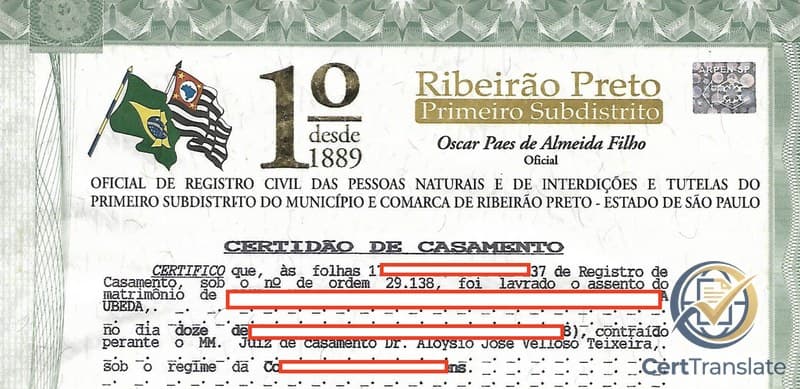
A client submitted a Brazilian marriage certificate (Certidão de Casamento) issued on 12 January 2008 by the 1st Subdistrict Civil Registry of Ribeirão Preto, São Paulo — act no. 29,138 recorded on folha 172 of book B 237. The certified English translation was needed for a USCIS immigration filing.
The certificate is a single pre-printed cartório sheet. The registration paragraph is signed at the bottom by the drafting Authorized Clerk (Escrevente Autorizada). Immediately below that signature appears a second paragraph: 'Reconheço por semelhança a firma supra de [name], e dou fé' ('I hereby recognize by similarity the above signature of [name], and attest to the same'), followed by a second Authorized Clerk's signature and RG identification number.
The client wanted to know whether the two signatures meant the document had been notarized twice, amended after issuance, or tampered with. The answer is none of those — but only if the translation makes that clear.
Why This Required Special Handling
In the United States, a second signature on the face of an official record typically signals a later action — an amendment, a correction, or a separate notarization. A USCIS adjudicator reviewing a translation that simply shows '[Signature]' twice, with no context, may reasonably flag the document and issue a Request for Evidence.
In Brazil, the second signature means something different. Brazilian cartórios routinely add a 'reconhecimento de firma por semelhança' inline on the same sheet: the escrevente who drafted the record signs it, and a second escrevente on duty recognizes the first signature against the specimen-signature card kept by the office. Both signatures are produced on the date of issuance, at the same window, as part of the original act.
Omitting the second signature block would misrepresent the original. Reproducing it without explanation risks reading as an amendment. The translator's task is to reproduce both signature blocks faithfully and to document the cartório convention so the adjudicator can evaluate the certificate at face value.
How We Handled It
We reproduced the certificate's layout exactly. The main registration paragraph ends with the closing formula 'The foregoing is true and I hereby attest' followed by the drafting clerk's signature block: printed name, job title ('Authorized Clerk' — our rendering of 'Escrevente Autorizada'), and RG identification number.
Directly below, we reproduced the reconhecimento paragraph in the same position and order as in the original, with the second clerk's signature block laid out identically to the first. Both signatures are described in brackets as '[Signature]' where the handwriting is clearly a rubric; the printed names beside them are taken from the typed labels on the certificate.
The Portuguese phrase 'Reconheço por semelhança a firma supra' was translated as 'I hereby recognize by similarity the above signature' — the standard English rendering of this notarial formula. We preserved the other cartório elements on the sheet: the fee breakdown (Oficial / IPESP / Total in reais), the receipt reference ('Stamps collected via Receipt No. 010/2008'), the holographic authenticity label (0862AA182943 — FIRMA 1) described in brackets, and the round embossed subdistrict seal also described in brackets. The pre-printed 'Observações' (Remarks) field, which contained only a printed dotted line with no entry, was marked '[Blank in original]' rather than rendered as dots.
"The original certificate bears two clerks' signatures on the same page. The first signature belongs to the Authorized Clerk (Escrevente Autorizada) who drafted and issued the record. The second signature, below the Portuguese formula 'Reconheço por semelhança a firma supra' ('I hereby recognize by similarity the above signature'), belongs to a second Authorized Clerk on duty at the same office and constitutes a signature-recognition entry — a standard Brazilian cartório practice by which a second clerk certifies that the first clerk's signature matches the office's specimen-signature card. Both signatures were produced on the date of issuance and form part of the original act. The second signature is not a later amendment, a re-notarization, or an alteration of the record."

Two further Translator's Notes accompanied the certification block: one documenting the DD/MM/YYYY → Month DD, YYYY date conversion (for example, '12/01/2008' → 'January 12, 2008'), and one documenting the conversion of European number notation (comma decimal separator, period thousands separator) into US notation — '29.138' → '29,138'; 'R$ 2,75' → 'R$ 2.75'.
The Outcome
The certified translation was delivered to the client for inclusion in their USCIS filing. The Translator's Note preempts the natural question about why two signatures appear on the same sheet and frames the second as an original-issuance cartório convention rather than a post-hoc modification.
This is a routine pattern for Brazilian civil-registry documents: we see it on birth, marriage, and death certificates issued by 1st Subdistrict offices across São Paulo state and by cartórios in many other Brazilian municipalities. Since we first published a note on this convention in our internal translator manual, we have handled this pattern on more than thirty Brazilian civil-registry documents without an RFE related to the double signature.
What This Means for You
A Brazilian cartório certificate with two Authorized Clerks' signatures on the same page is issued that way by the office and is not evidence of tampering, amendment, or double notarization. A certified translation that preserves both signature blocks and adds a Translator's Note explaining the reconhecimento de firma por semelhança gives the USCIS adjudicator the context needed to evaluate the document at face value.
Have a similar situation?
We handle Brazilian cartório-issued marriage, birth, and death certificates with double signature blocks regularly.
Related Cases & Resources
Sources & References
- Meet Translation Requirements·USCIS·Verified 2026-05-29
Explore the Hub
Certified Translation
Documents
Languages
Immigration
Accepted By
All identifying information has been removed from document images. Case details are shared with client permission. No personal data is stored or displayed on this page.