




Why does a Chinese PhD transcript list Marxism as a required course, and what should the translation say?
TL;DRA Chinese PhD transcript from Peking Union Medical College listed two Marxism courses as required subjects — mandatory political education for every mainland-China doctoral candidate — and used a placeholder course-name field for the program's primary specialized course. We translated each course name in full, mapped the five-tier Chinese course-type taxonomy into descriptive English categories, and preserved the placeholder convention with a Translator's Note explaining all four registry-system features. The certified translation was delivered for credential evaluation.
Case Specifications
- Document
- Doctoral student transcript
- Foreign Name
- 博士研究生成绩单
- Country
- China
- Languages
- Chinese (Simplified) → English
- Submitted To
- Credential evaluation (receiving evaluator not specified by client)
What We Received
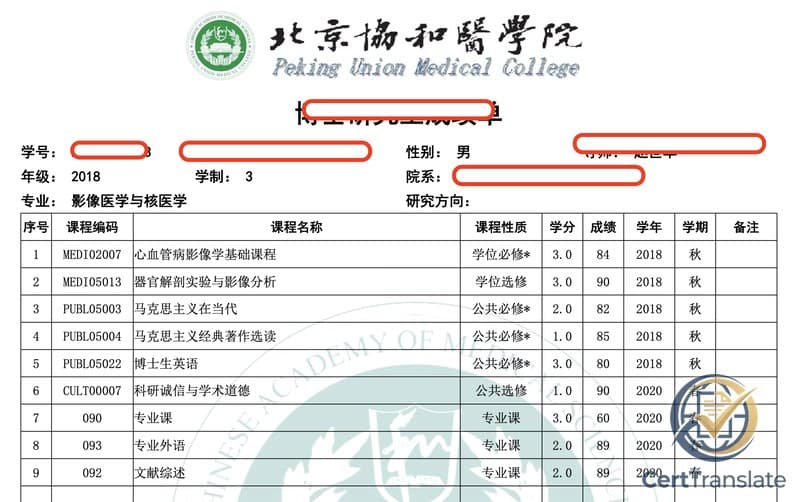
A client submitted a single-page Chinese doctoral transcript (博士研究生成绩单) issued by Peking Union Medical College / Chinese Academy of Medical Sciences (北京协和医学院 / 中国医学科学院). The candidate was admitted in 2018 to a three-year clinical PhD program in Imaging Medicine and Nuclear Medicine (影像医学与核医学), with the academic department listed as Fuwai Hospital (阜外医院) — the affiliated cardiovascular research hospital.
The course table had nine rows; five were marked with an asterisk as required. Two of those required courses were Marxism in Contemporary Times (马克思主义在当代) and Selected Readings of Marxist Classics (马克思主义经典著作选读) — political-education subjects that appear on every mainland-China graduate transcript regardless of field. The other three required courses were Doctoral English, the discipline-specific Cardiovascular Imaging Fundamentals course, and the program's primary specialized course.
That specialized component appeared with a peculiarity: instead of the nine-character department-prefixed codes used elsewhere (MEDI02007, PUBL05003, CULT00007), it carried a three-digit internal code (090), and its Course Name field simply read "专业课" — exactly the same two characters that appeared in the Course Type column. The certified translation was needed for Chinese-to-English credential evaluation.
Why This Required Special Handling
Chinese graduate transcripts use a five-tier course-type taxonomy that does not map onto the U.S. required/elective binary: 学位必修 (Required for the Degree), 学位选修 (Elective for the Degree), 公共必修 (Public-Required — mandatory across all programs, including political education), 公共选修 (Public-Elective), and 专业课 (Specialized Course — the program's own primary requirements). Flattening these loses information that a credential evaluator needs.
The Marxism courses are not fillers — they carry credit weight (1.0–2.0 credits) and contribute to the weighted average. A translator who omits or generalizes them ("Public Coursework") misrepresents the transcript. A translator who renders them literally without context risks making the document look ideologically charged to a U.S. reader who does not know every Chinese PhD candidate in every field completes the same political-education sequence.
The placeholder course-name issue is separate. A naïve translator either copies the duplicate ("Specialized Course | Specialized Course") and leaves the reader wondering whether it is a transcription error, or invents a substantive name not in the original. Neither is acceptable: the first looks like a mistake, the second is a fabrication.
How We Handled It
We translated every course name in full and gave each its real meaning — "Marxism in Contemporary Times" and "Selected Readings of Marxist Classics" appear in the English transcript exactly as they do in the original, with no euphemistic relabeling. We did not move them to a footnote or a separate section; they remain in their original sequence in the course table, with their credits and grades intact.
For the course-type column, we mapped the five Chinese categories into descriptive English labels that preserve the original distinctions: 学位必修 → "Required for Degree," 学位选修 → "Elective for Degree," 公共必修 → "General Required," 公共选修 → "General Elective," 专业课 → "Specialized Course." The asterisk convention marking required courses was preserved with a footer note matching the original ("* Indicates required courses").
For the placeholder course-name row (course code 090), we transcribed it exactly as it appears in the original — the English entry reads "Specialized Course" in both the name and the type column, mirroring the source — and we documented this as a registry-system convention in a Translator's Note rather than substituting an invented course title.
"1. Personal names have been transliterated using standard Hanyu Pinyin (王毅晖 → Wang Yihui; 赵世华 → Zhao Shihua); the institution's official English name (Peking Union Medical College) appears pre-printed on the original. 2. The issuance date in the original is rendered in YYYY-MM-DD format (2023-10-16) and has been reproduced as October 16, 2023 in this translation. 3. The original transcript uses a five-tier course-type taxonomy (学位必修 / 学位选修 / 公共必修 / 公共选修 / 专业课); these have been rendered as "Required for Degree," "Elective for Degree," "General Required," "General Elective," and "Specialized Course" respectively, preserving the source distinctions. The asterisk convention from the original ("加*的为必修课" — "Courses marked with * are required") has been preserved. 4. Rows 3 and 4 (Marxism in Contemporary Times and Selected Readings of Marxist Classics) are mandatory political-education courses required of every mainland-China doctoral candidate regardless of field of study; they are translated literally as they appear in the original. 5. Row 7 carries the program-internal three-digit course code 090; the Course Name field in the original consists of the same two characters (专业课) that appear in the Course Type column. This is a registry-system placeholder for the program's primary specialized course, not a substantive course title; the duplicate has been preserved verbatim as "Specialized Course" in both columns. 6. The field 研究方向 (Research direction) and the 备注 (Remarks) column are blank in the original. 7. Grades are reported on the institution's 100-point scale exactly as they appear in the original."

The official seal was transcribed in full inside bracket notation, with both Chinese and English rim text reproduced ("北京协和医学院研究生院 / PEKING UNION MEDICAL COLLEGE GRADUATE SCHOOL" with center inscription "成绩单专用章 / Official Transcript Seal"). The light-green emblem watermark across the page background was described in a separate bracketed note so a reviewer would not mistake it for a missing element.
The English rendering reproduces the original's portrait A4 layout with the nine-column table structure and the student-information block intact.
The Outcome
The certified translation was delivered to the client for submission to a U.S. credential evaluator. The Translator's Note gives the evaluator full visibility into four registry-system conventions that would otherwise be invisible: the Pinyin name romanization, the YYYY-MM-DD date format, the five-tier course-type taxonomy, and the placeholder course-name convention.
We see this transcript pattern — mandatory political-education courses interleaved with discipline coursework, and program-internal placeholder codes for the specialized component — on every mainland-China graduate transcript we translate. The approach used here generalizes to any Chinese PhD or master's transcript translation destined for WES, ECE, or institution-specific evaluation.
What This Means for You
A certified translation of a Chinese graduate transcript should preserve the political-education courses verbatim, map the five-tier Chinese course-type taxonomy into descriptive English categories rather than collapsing it into Required/Elective, and reproduce placeholder course-name entries exactly as they appear in the original — with a Translator's Note explaining the registry-system conventions. Do not let a translator generalize, omit, or invent: a credential evaluator needs to see what the original actually says, with the cultural context provided in the note.
Have a similar situation?
We translate Chinese PhD and master's transcripts for credential evaluation regularly.
Related Cases & Resources
Sources & References
- WES Required Documents — China·WES·Verified 2026-06-05
Explore the Hub
Certified Translation
Documents
Languages
Immigration
Accepted By
All identifying information has been removed from document images. Case details are shared with client permission. No personal data is stored or displayed on this page.