




Why does a Russian birth certificate list 'nationality' separately from 'citizenship,' and how should that be translated for USCIS?
TL;DRA 2006 Russian birth certificate from the Perovsky Civil Registry Office of Moscow carried, per parent, two separate fields — «гражданство» (citizenship) and «национальность» (ethnicity, not nationality) — with independent fill states. The certified translation for USCIS rendered «национальность» as 'Ethnicity,' rendered «гражданство» as 'Citizenship,' preserved the blanks as '[Blank in original],' and added a Translator's Note documenting the field distinction. The translation was delivered without a USCIS request for evidence on the field structure.
Case Specifications
- Document
- Birth certificate
- Foreign Name
- Свидетельство о рождении
- Country
- Russia
- Languages
- Russian → English
- Submitted To
- USCIS
What We Received
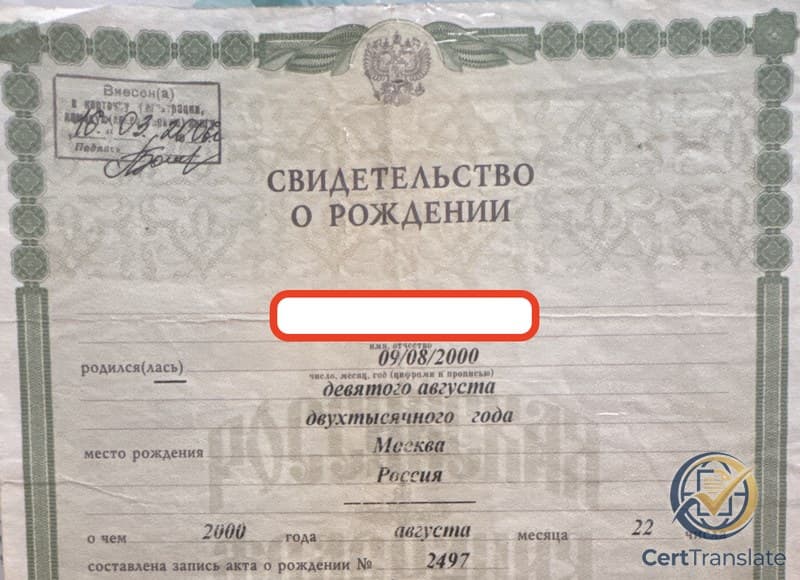
A client submitted a post-Soviet Russian Свидетельство о рождении — a single-page printed form, Series III-МЮ № 559052 — issued on March 3, 2006 by the Perovsky Civil Registry Office (ЗАГС) of the City of Moscow for a registrant born August 9, 2000. The form lays out the registrant's data and the data of each parent in a column of pre-printed Russian-language field labels with the values written in above each label. The translation was needed alongside other identity documents for a USCIS filing.
Two of those pre-printed labels are the source of this case. For each parent, the form carries «гражданство» (citizenship) AND «национальность (вносится по желанию)» (ethnicity, entered at the parent's request). On this document the mother's ethnicity was filled («русская») while her citizenship line was blank; the father's citizenship was filled («гражданин России») while his ethnicity line was blank. The client wanted a certified Russian birth certificate translation that read cleanly to a USCIS adjudicator — without the appearance of contradicting itself.
Why This Required Special Handling
On Soviet and post-Soviet civil-registry forms, «гражданство» and «национальность» are two different concepts and two different fields. «Гражданство» is citizenship in the legal sense — what state you are a citizen of. «Национальность» is the Soviet-era ethnic-identity marker — Russian, Tatar, Armenian, Jewish, and so on — recorded historically on internal passports and still carried, optionally, on civil-registry forms for parents who choose to declare it. The two are independent: a Russian citizen may decline to state an ethnicity, and an ethnicity declaration is not a citizenship declaration.
In US English, 'nationality' and 'citizenship' are usually interchangeable. A USCIS adjudicator reading 'Nationality: Russian' next to 'Citizenship: [blank]' on a parent line reads it as a citizenship contradiction — the form appears to declare a nationality but withhold a citizenship, or vice versa. That is not what the Russian form says. The Russian form deliberately keeps two fields apart and lets each be filled or left blank on its own. Per USCIS translation requirements, the certified translation must be complete and accurate — which here means preserving the two-field structure rather than collapsing it into the closer English vocabulary.
The translator's job, in other words, was to find an English label for «национальность» that does NOT read as citizenship. The accepted convention on Soviet- and post-Soviet civil-registry translations is 'Ethnicity' — the term that captures the Soviet-era ethnic-identity meaning of «национальность» and is unambiguous in US English. Choosing 'Nationality' instead is the canonical pitfall on this document family.
How We Handled It
We rendered «гражданство» as 'Citizenship' and «национальность» as 'Ethnicity' throughout the translation, keeping the two-field structure intact for each parent. Where a field was filled, we translated the value (the mother's ethnicity 'русская' became 'Russian'; the father's citizenship 'гражданин России' became 'citizen of Russia'). Where a field was blank, we marked it '[Blank in original]' rather than leaving the line empty or carrying over the other parent's value — the blank is itself information on a Russian civil-registry form, not an oversight to fix.
The Cyrillic series identifier on the form, 'III-МЮ № 559052,' was preserved with the Cyrillic series letters intact (a transliteration of 'МЮ' would not match how Russian databases and Russian-issued reissues reference the series). Date notations were converted from the source's two-fold notation (digits '09/08/2000' plus the spelled-out Russian form 'девятого августа двухтысячного года') to the unambiguous 'August 9, 2000 — the ninth of August in the year two thousand,' so the US-format date and the original Russian phrasing both appear in the translation. The administrative endorsement stamp in the upper-left of the original (entry into the house register / registration card on March 16, 2006, with an illegible signature) and the official round seal of the Perovsky Civil Registry Office at the bottom of the page were each described in brackets at their original positions.
"Translator's Note 1 — Field structure: The original document carries, for each parent, two separate pre-printed fields: «Гражданство» (Citizenship) and «Национальность» (Ethnicity, entered at the parent's request). These are independent fields with independent fill states. «Национальность» on Soviet/post-Soviet civil-registry forms denotes ethnic identity, not citizenship, and is rendered here as 'Ethnicity' to avoid the US-English conflation of 'nationality' with citizenship. Translator's Note 2 — Per-parent fill state: On this document the mother's «Национальность» is filled («русская», rendered 'Russian') while her «Гражданство» field is blank; the father's «Гражданство» is filled («гражданин России», rendered 'citizen of Russia') while his «Национальность» field is blank. Each blank field is preserved as '[Blank in original]' in the translation. Translator's Note 3 — Series identifier and dates: The Cyrillic series identifier 'III-МЮ № 559052' is preserved in Cyrillic in the translation; the document number 559052 is preserved unchanged. Dates in the original appear in DD/MM/YYYY format and have been rendered as Month DD, YYYY in this translation (09/08/2000 → August 9, 2000), with the Russian-language spelled-out form preserved alongside the digit form, mirroring the original's two-fold notation."

The translation was delivered in our standard CertTranslate layout with the Translator's Certification block on the final page.
The Outcome
The certified translation was delivered for the client's USCIS filing, with the two-field structure preserved and the field distinction explained in the Translator's Notes. A USCIS adjudicator reading the page can see that the mother's ethnicity is declared and her citizenship field was left blank on the original — not that the original is internally inconsistent.
We have applied the same approach on every Russian-language post-Soviet civil-registry document we have translated for USCIS — birth certificates, marriage certificates, divorce certificates — where the «гражданство» / «национальность» pair appears, without an RFE on the field structure.
What This Means for You
A certified Russian birth certificate translation for USCIS must render «национальность» as 'Ethnicity' (not 'Nationality') and «гражданство» as 'Citizenship,' preserving the two-field structure and any blanks exactly as they appear on the original. If your translator merged the two fields under a single English label or filled in a blank from context, the translation has flattened a structural distinction the Russian form deliberately preserves and should be corrected before submission.
Have a similar situation?
We translate Russian birth, marriage, and divorce certificates — preserving the «гражданство» / «национальность» two-field structure and rendering blanks faithfully — for USCIS filings regularly.
Related Cases & Resources
Sources & References
- Meet Translation Requirements·USCIS·Verified 2026-06-12
- Romanization System for Russian — BGN/PCGN 1947·U.S. Board on Geographic Names / Permanent Committee on Geographical Names (UK)·Verified 2026-06-12
Explore the Hub
Certified Translation
Documents
Languages
Immigration
Accepted By
All identifying information has been removed from document images. Case details are shared with client permission. No personal data is stored or displayed on this page.