




How should a multi-page Mexican denuncia be translated when the narrative breaks mid-sentence at the page boundary?
TL;DRA two-page Mexican denuncia from the Office of the Attorney General of Justice of Tamaulipas had its witness narrative split mid-sentence at the page break, with the institutional letterhead repeating in two corners of each page and the registry address block in each bottom-right. The certified English translation reproduced each repeating boilerplate element only once, joined the narrative seamlessly across the original page break with a small inline marker, and documented both layout decisions in Translator's Notes.
Case Specifications
- Document
- Criminal complaint (denuncia)
- Foreign Name
- Denuncia / Querella
- Country
- Mexico
- Languages
- Spanish → English
- Submitted To
- U.S. legal filing (receiving authority not specified by client)
What We Received
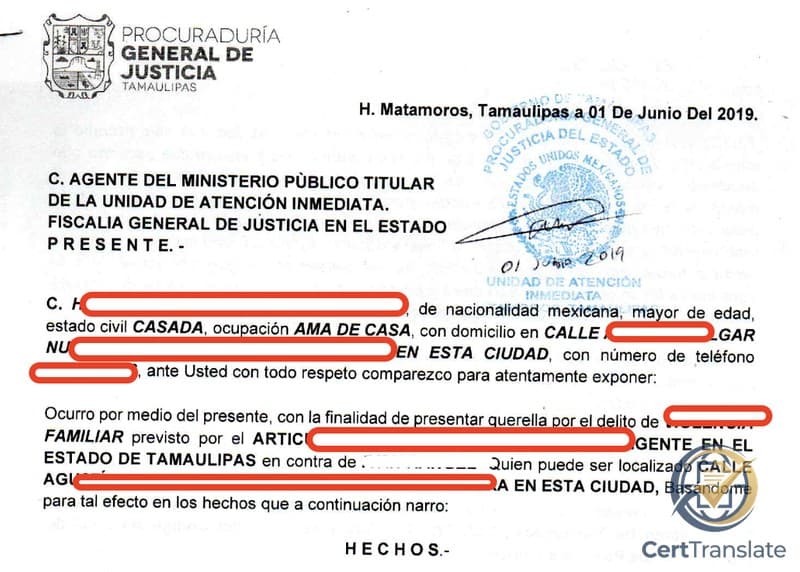
A client submitted a two-page Mexican denuncia — a criminal complaint filed before the Office of the Attorney General of Justice of the State of Tamaulipas (Procuraduría General de Justicia del Estado de Tamaulipas), Immediate Attention Unit, in H. Matamoros. The complaint named the offense (family violence under Article 368 BIS of the Penal Code in force in the State of Tamaulipas), set out the witness's narrative under a 'HECHOS' heading on page 1, and continued onto page 2 with the petitorio and the formal closing.
On both pages, the same coat-of-arms letterhead block ('PROCURADURÍA GENERAL DE JUSTICIA — TAMAULIPAS') appeared in the top-left corner and again in the bottom-left corner, and the same multi-line institutional address block sat in each bottom-right corner. The narrative on page 1 ended in the middle of a sentence ('…it was already approximately'); page 2 picked it up directly with '23:30 hours, I remained in the bedroom…'. The certified Spanish translation was needed for the client's U.S. legal filing; the receiving authority was not specified by the client.
Why This Required Special Handling
On a multi-page foreign legal filing, what to do with repeating institutional boilerplate is not a formatting preference — it is a readability decision. Reproducing each letterhead and each address block in the translation, once for every original page, interrupts the narrative with text that the original positions outside the narrative. A U.S. reviewer is then asked to re-orient on every page even though, in the source, the narrative is continuous.
Per USCIS translation requirements, the certified translation must be a complete and accurate rendering of the source — but 'complete' is not the same as 'reproduced four times.' A repeating header is a single piece of information that the issuing office prints on every page of its forms; the translation can convey that fact once, with a note explaining the layout, without losing any of the original's content.
The page break itself raises the same question. When an unfinished sentence runs from page 1 onto page 2, padding the seam with a reprinted letterhead and address footer severs the syntactic link the original keeps intact — a translator's note about the seam ends up reading the original through a structure the original does not have.
How We Handled It
We rendered each repeating element once. The institutional letterhead — coat of arms of the State of Tamaulipas + 'Procuraduría General de Justicia — Tamaulipas' — was placed once at the head of the translated body, and the multi-line registry address block was placed once at the foot. The witness narrative ran as a single continuous paragraph: page 1's closing fragment '…it was already approximately' was joined directly to page 2's opening '23:30 hours, I remained in the bedroom…' with no inserted boilerplate between them.
At the precise stitch point we placed a discreet inline marker, '[Original page 2 begins],' formatted in italic 8-point grey type so a reviewer can locate the original split without reading the marker as part of the witness statement. Two Translator's Notes documented the layout calls:
"Translator's Note 1 — Repeating institutional boilerplate: The institutional letterhead (coat of arms of the State of Tamaulipas + 'PROCURADURÍA GENERAL DE JUSTICIA — TAMAULIPAS,' rendered as 'OFFICE OF THE ATTORNEY GENERAL OF JUSTICE — TAMAULIPAS') appears in two positions on each of the two original pages — the top-left corner and the bottom-left corner — and the institutional address block ('OFFICE OF THE ATTORNEY GENERAL OF JUSTICE — IMMEDIATE ATTENTION UNIT. MARTE R. GÓMEZ AVE., S/N…') appears in the bottom-right corner of each page. Both repeating elements have been reproduced once in this translation — the letterhead at the head of the document and the address block at the foot — to avoid interrupting the continuous narrative. Translator's Note 2 — Page break across an open sentence: The narrative crosses the original page break mid-sentence (page 1 ends with '…it was already approximately' and page 2 begins with '23:30 hours, I remained in the bedroom…'). The two halves have been joined seamlessly to preserve the sense; a small italicized marker '[Original page 2 begins]' has been inserted at the exact split point so the reader can locate it."

Supplementary Translator's Notes covered the formal Mexican legal closing ('PROTESTO A USTED LO NECESARIO EN DERECHO,' rendered as 'I HEREBY ATTEST AS LEGALLY REQUIRED' to preserve the solemn register), the honorific 'C.' (Ciudadano/Ciudadana) retained in its abbreviated form, the vulgar register of the reported speech, the 24-hour time notation with U.S. 12-hour equivalents, and the original document's typographical errors and inconsistent diacritics. The receipt stamps on the top of page 1 (round seal of the Office of the Attorney General + the Immediate Attention Unit's date stamp) were described in brackets at their original location, in line with the certificate of accuracy standard for legal narrative translations accepted by USCIS.
The Outcome
The certified translation was delivered to the client for the U.S. legal filing. The two layout-decision Translator's Notes give any future reviewer the context to read the consolidated boilerplate and the seamless mid-sentence join as deliberate translation choices, not as omissions or transcription errors.
What This Means for You
A multi-page foreign legal narrative reads cleanest when its repeating institutional boilerplate is reproduced once — not on every page — and when a sentence that the original splits across pages is joined seamlessly in the translation, with a discreet marker at the stitch point. A certified Spanish-to-English translation of a Mexican denuncia or any comparable narrative legal filing prepared this way preserves the document's full content and lets a U.S. reader follow the witness statement from start to finish without re-orienting at every page break.
Have a similar situation?
We translate Mexican denuncias, querellas, court filings, and other multi-page narrative legal documents — Spanish to English, with Translator's Notes documenting layout decisions — for U.S. immigration filings, family-court matters, and civil cases regularly.
Related Cases & Resources
Sources & References
- Meet Translation Requirements·USCIS·Verified 2026-06-13
Explore the Hub
Documents
Languages
Immigration
Accepted By
All identifying information has been removed from this case study. Case details are shared with client permission. No personal data is stored or displayed on this page.