




How do you translate an apostilled US divorce decree into Brazilian Portuguese for averbação at a cartório?
TL;DRAn apostilled New Hampshire divorce decree had to be translated from English into Brazilian Portuguese for averbação at a Brazilian cartório. We mirrored the court form's grid and checkboxes in Portuguese, glossed every MM/DD/YYYY date in spelled-out Brazilian form, and retained 'Justice of the Peace' and 'Marital Master' in English because no Brazilian role matches them one-to-one — keeping the apostille's scope tied to the underlying decree.
Case Specifications
- Document
- Divorce certificate (with state Apostille)
- Foreign Name
- Certificate of Divorce, Civil Union (CU) Dissolution, Legal Separation Or Annulment + Apostille (Convention de La Haye du 5 Octobre 1961)
- Country
- United States of America
- Languages
- English → English
- Submitted To
- Brazilian cartório (averbação of foreign divorce)
What We Received
A client submitted a two-page apostilled divorce packet from the State of New Hampshire and asked for a certified divorce certificate translation into Brazilian Portuguese. The packet was being prepared for averbação — recording the foreign divorce on the spouse's Brazilian marriage certificate at a cartório de registro civil — and the country of destination box on the apostille named Brazil.
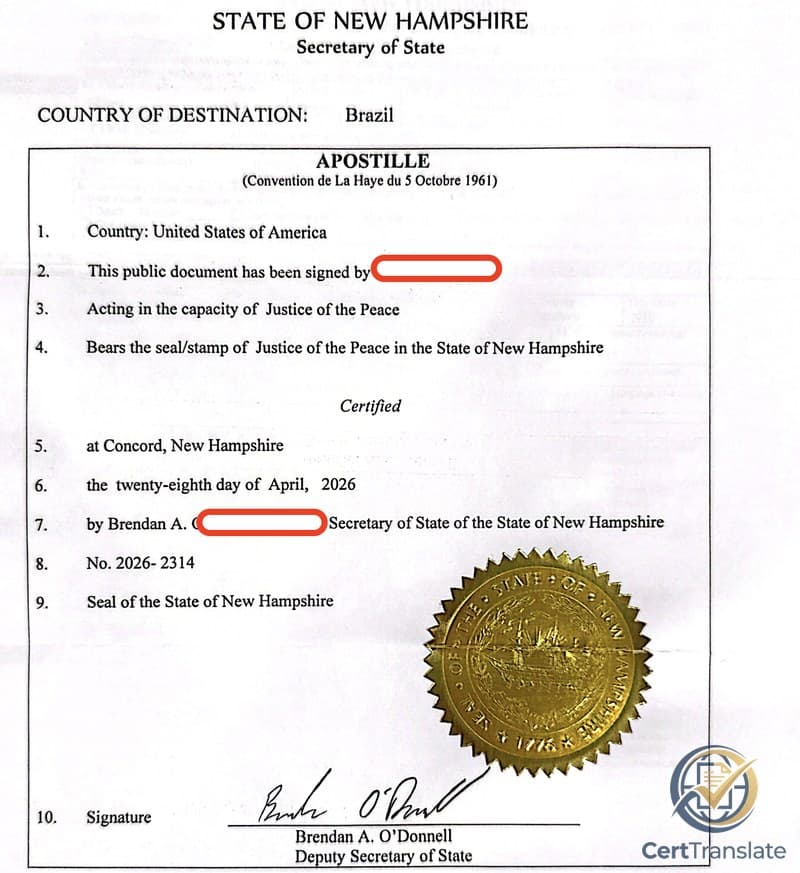
Page 1 was the New Hampshire Apostille issued by the Office of the Secretary of State (Apostille No. 2026-2314), authenticating the signature of the New Hampshire Justice of the Peace who had signed the underlying certificate. Page 2 was the underlying decree — the New Hampshire Certificate of Divorce, Civil Union (CU) Dissolution, Legal Separation Or Annulment, on form SOS/DVRA VS 14A Rev 12/2010 — completed by counsel and signed by the court official, with the divorce final in 2012 and a court official's date of 2013.
The packet did not need an inbound USCIS-style translation. It needed the opposite: a reverse-direction English-to-Brazilian-Portuguese translation that a Brazilian cartório official could use directly.
Why This Required Special Handling
Brazilian cartórios accept a foreign divorce for averbação only when it arrives as a translated apostilled decree. Since 2017, a consensual foreign divorce no longer requires a separate homologation by the Superior Tribunal de Justiça — the cartório can record it directly under CNJ Provimento N. 53/2016, provided the translation is faithful and the apostille is in order. The translation is the document the cartório official actually reads.
The NH Certificate of Divorce is not a paragraph of legal text — it is a numbered grid of fields, checkboxes, and short data entries (Person A, Person B, Marriage, Attorney, Decree, court signature). A faithful translation has to preserve the grid: same field numbers, same checked and unchecked boxes, same blank lines, same internal cross-references (1a–1c, 10a–10c, 27a, 27b). Converting the form into Portuguese prose forces the cartório official to re-derive the structure and is exactly the kind of formatting drift that triggers a re-do.
Three smaller problems sit on top of the grid. US MM/DD/YYYY dates are ambiguous to Brazilian readers, who default to DD/MM/YYYY. Two NH-specific roles named on the form — 'Justice of the Peace' and 'Marital Master' — have no clean Brazilian equivalent (a JP is neither a juiz de paz brasileiro nor a tabelião; a Marital Master is a court-appointed quasi-judicial officer in family matters), and a literal calque would mislead. And US court forms tolerate blank fields by design (the State File Number, optional suffixes, the unfilled Number line on Item 17) — silently dropping them in Portuguese is an omission, not a stylistic shortcut.
How We Handled It
We mirrored the source layout exactly. The Portuguese DOCX reproduces the NH form as a grid of bordered cells with the same numbered field labels (Pessoa A, Pessoa B, Casamento / União Civil, Advogado, Decreto) and the same checkbox states ('☒ Feminino', '☒ Divórcio', '☒ Diferenças irreconciliáveis', '☒ Audiência não contestada', '☒ Juiz', '☒ Nome anterior ao 1º casamento ou união civil' for Person A, '☒ Mesmo nome atual' for Person B). The form ID line — 'SOS/DVRA VS 14A Rev 12/2010' — was preserved verbatim so the cartório can identify the source.
Every numeric date kept its source MM/DD/YYYY form and was immediately glossed in spelled-out Portuguese in parentheses: '01/28/1982 (28 de janeiro de 1982)', '08/09/2009 (9 de agosto de 2009)', '06/28/2012 (28 de junho de 2012)', '06/05/2013 (5 de junho de 2013)'. The numeric form keeps an audit trail back to the source; the spelled-out form removes the DD/MM vs MM/DD ambiguity a Brazilian reader would otherwise have to resolve from context.
'Justice of the Peace' and 'Marital Master' were retained in English with a parenthetical Portuguese gloss on first mention. A Translator's Note made the reasoning explicit: these are NH-specific judicial roles, and the cartório official needs the source title — not a guess at a Brazilian equivalent — to match the apostille against the underlying signature. Every blank field was marked '[Em branco no original]' (the State File Number, Person A's suffix, Person B's suffix and pre-marriage surname, the unfilled Number line on Item 17). The cursive court-official signature in field 32a was marked '[Assinatura ilegível]' over the visible court seal.
The standard French heading on page 1 — 'Apostille (Convention de La Haye du 5 Octobre 1961)' — was kept in French per the Convention's fixed format, and the surrounding apostille body was translated into Portuguese. On the certification page, the scope statement names both pages so the cartório can see, from the certification alone, that the apostille authenticates the underlying decree.
"The original is a two-page packet — page 1 is a New Hampshire Apostille (Hague Convention of 5 October 1961) issued for use in Brazil, and page 2 is the New Hampshire Certificate of Divorce, Civil Union (CU) Dissolution, Legal Separation Or Annulment, on form SOS/DVRA VS 14A Rev 12/2010. Dates in the original appear in MM/DD/YYYY format; they are reproduced in their original numeric form, accompanied by the spelled-out Brazilian Portuguese form in parentheses to remove any DD/MM vs. MM/DD ambiguity. Form fields left empty in the original are marked '[Em branco no original]'. The signature of the court official in field 32a (over an embossed court seal) is in cursive handwriting and is illegible; it has been marked accordingly. The titles 'Justice of the Peace' and 'Marital Master' are New Hampshire-specific judicial roles with no exact Brazilian equivalent; they are retained in English with a Portuguese gloss where helpful."

The Outcome
The two-page certified Brazilian Portuguese translation was delivered to the client for the cartório, packaged as a single DOCX whose body mirrors the original packet page-for-page, followed by a translator's certification that names both the apostille and the underlying decree. The cartório official, reading the Portuguese translation alongside the apostilled English original, can match field by field — case number, decree date, hearing official, court — without re-deriving the form's structure or guessing at an MM/DD date.
We have used the same approach on every reverse-direction US-to-Brazil court packet since 2024 — divorce decrees, court orders, name-change judgments — without a cartório re-do request on the form-grid or the US-title handling.
What This Means for You
A US divorce decree being translated into Brazilian Portuguese for averbação should mirror the source court form field by field, gloss every numeric date in spelled-out Portuguese, and retain US-specific judicial titles in English with a Portuguese explanation rather than substituting a Brazilian role that does not match. The translation is what the cartório official reads — the closer it tracks the source, the cleaner the averbação.
Have a similar situation?
We translate apostilled US court packets into Brazilian Portuguese for cartório averbação — divorce decrees, name-change orders, custody and adoption judgments — and back into English for USCIS. Reverse-direction certified translation, $24.95/page, delivered in 24 hours.
Related Cases & Resources
Sources & References
- Convention of 5 October 1961 Abolishing the Requirement of Legalisation for Foreign Public Documents·Hague Conference on Private International Law (HCCH)·Verified 2026-06-15
- Provimento N. 53/2016 — Averbação direta de divórcio consensual obtido no estrangeiro·Conselho Nacional de Justiça (CNJ) — Brazil·Verified 2026-06-15
- Justice of the Peace — Office of the New Hampshire Secretary of State·New Hampshire Secretary of State·Verified 2026-06-15
Explore the Hub
Certified Translation
Documents
Languages
All identifying information has been removed from document images. Case details are shared with client permission. No personal data is stored or displayed on this page.