





What do you do when a handwritten birth-certificate scan is too degraded to translate accurately for USCIS?
TL;DRA handwritten Saudi Arabian birth certificate (شهادة ميلاد) from the Ministry of Health was submitted as a low-contrast multi-generation photocopy in which the mother's name, both parents' civil-register and passport numbers, the place of birth, the parents' occupations, the registration date written in Arabic words, and the issuing office could not be reliably read. After a clarification request did not produce either a higher-quality original or written confirmation of the unreadable values, we declined the order, refunded the client in full, and directed them to request a freshly issued certified extract from the Saudi civil-status office before resubmitting for USCIS.
Case Specifications
- Document
- Birth certificate
- Foreign Name
- شهادة ميلاد (Shahādat Mīlād)
- Country
- Saudi Arabia
- Languages
- Arabic → English
- Submitted To
- USCIS
What We Received
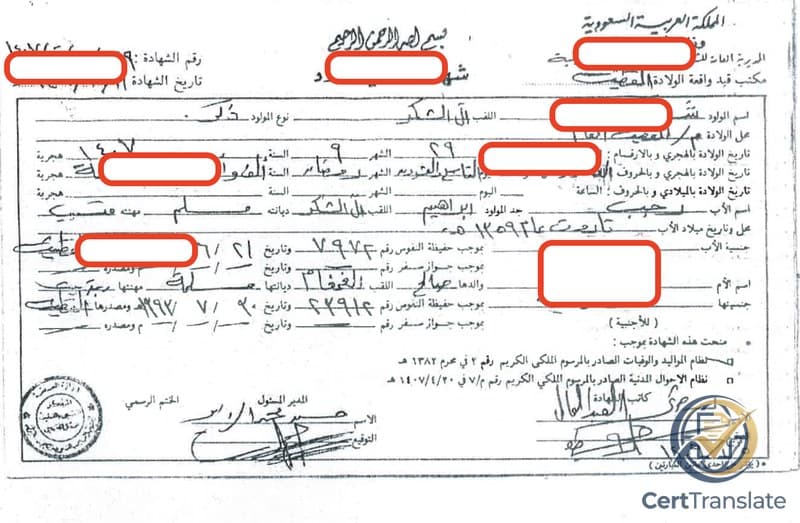
A client submitted a Saudi Arabian birth certificate (شهادة ميلاد) issued by the Ministry of Health, General Directorate of Health Affairs, for a USCIS filing. The certified birth certificate translation was being prepared as part of a USCIS-bound packet; the client had supplied the Latin spelling of his own name as it appears on his passport, which let us reconcile the father's-side name chain on the form (given name, father's name, paternal grandfather's name, family name).
The form is a pre-printed Saudi civil-registry sheet referencing Royal Decree No. 2 of 1 Muharram 1382 H and Royal Decree No. M/7 of 20/4/1407 H. The handwritten entries are made in Arabic, in deliberate hand, but the file we received is a multi-generation low-contrast photocopy. A wide ink overlay covers part of the lower signature block; several other handwritten entries have degraded to the point that individual letter shapes cannot be reliably distinguished from one another.
Roughly seventy percent of the form is handwritten — and on this scan, most of those handwritten entries are not readable with the certainty an identity-grade Arabic translation requires.
Why This Required Special Handling
USCIS requires a certified translation to be a complete and accurate rendering of the source document, with the translator attesting under signature that they are competent to translate from the source language and that the translation is true and accurate. "Accurate" leaves no room for guessing. On an identity document, a plausibly-spelled mother's name or a "best-guess" digit in a civil-register number is not an accurate translation of the source — it is the translator substituting their own reading for what the document actually says, which is exactly what a USCIS adjudicator is trained to flag.
The fields that could not be read on this scan with the certainty the USCIS certified-translation standard requires were: the mother's full name; the maternal grandfather's name; both parents' civil-register (حفيظة النفوس) numbers and the offices that issued them; both parents' passport numbers and issuing offices (where listed); the handwritten place of birth; the date and time of birth written out in Arabic words; the parents' occupations; the city or district of the issuing birth-registration office; and the certificate number and issue date at the top of the form.
The passport spelling supplied by the client resolves only the father's-side name chain — the rest of the form remains handwritten on a degraded scan. Standard cross-document name-consistency checks are not available either: the client did not supply a national ID, a parental record, or any other document that would let us anchor the mother's-side names against another source. We sent a clarification request listing every unreadable field and asking for either a fresh higher-quality original or written confirmation of each remaining value as it appears on the client's official records. The client was unable to supply either.
How We Handled It
We declined the order rather than translate fields we could not read with confidence. The order was canceled, a full refund was issued to the original payment method, and the client was given two specific paths to a usable certified translation: either request a freshly issued certified extract from the Saudi civil-status office that originally registered the birth (which produces a clean printed record), or obtain a notarized true copy through the Saudi consulate where they currently reside.
The decision was not about Arabic being hard to translate. Our Arabic translation desk regularly translates handwritten Saudi, Egyptian, Jordanian, and Levantine civil-registry documents for USCIS. The decision was about scan quality: when a handwritten foreign civil-registry source arrives as a degraded multi-generation photocopy, no amount of language expertise compensates for what is not on the page. A partial certification — translating only the printed letterhead and the legal-decree references while leaving the handwritten name and ID fields blank — would create more confusion than it resolves and would not satisfy the USCIS "complete and accurate" standard on its face.
A note went into the order record explaining the decision so any future translator who picks up a related order from the same client starts with full context, including the passport spelling we already have for the father's-side name chain.
The Outcome
The order was canceled and the customer was refunded in full to the original payment method. We did not issue a certified translation of any portion of the document; the client was given two named, specific avenues for obtaining a clean source document and was invited to start a new order once a freshly issued copy is in hand.
We decline a small but consistent number of orders for the same reason every year — most often older Saudi, Egyptian, and Iraqi handwritten civil-registry documents that arrive as multi-generation photocopies. The client's path forward in every case is the same: a freshly issued certified copy from the original issuing office produces a translation that USCIS can rely on, and is almost always faster end-to-end than an RFE caused by a guess at an unreadable field.
What This Means for You
A certified translation cannot be more accurate than the source document it is translating. When a handwritten foreign civil-registry document arrives as a degraded photocopy and key identity fields are not reliably readable, the right action is to obtain a freshly issued certified copy from the original issuing office — or a notarized true copy from the relevant consulate — before requesting translation. A translator who guesses at unreadable handwritten names and numbers on an identity document is not delivering a more useful result than one who refuses the order and explains why.
Have a similar situation?
We translate handwritten Arabic civil-registry documents from Saudi Arabia, Egypt, Jordan, Lebanon, and the wider Arab world for USCIS regularly — when the source is legible enough to translate accurately. If you're not sure whether your scan is usable, ask before ordering.
Related Cases & Resources
Sources & References
- Meet Translation Requirements·USCIS·Verified 2026-06-04
Explore the Hub
Certified Translation
Documents
Languages
Immigration
Accepted By
All identifying information has been removed from the published case description. Case details are shared with client permission. No personal data is stored or displayed on this page.