What Is a Свідоцтво Про Народження?
Свідоцтво про народження translates literally to "certificate of birth." It is the official birth registration document issued by Ukraine's civil registry system. Every birth registered in Ukraine generates this document, and it serves as the primary proof of identity, parentage, and citizenship for Ukrainian nationals.
The document is issued by the РАЦС (Реєстрація Актів Цивільного Стану) — the Registry of Civil Status Acts, which operates under Ukraine's Ministry of Justice through regional offices called ДРАЦС (Департамент реєстрації актів цивільного стану). Before 1991, the same function was performed by ЗАГС (Запис Актів Громадянського Стану) under the Soviet system. Understanding which system issued the document tells the translator which format to expect and how to handle the content.
For people preparing Ukrainian documents for U.S. immigration, courts, or universities, the birth certificate is almost always the first document in the packet. It anchors the person's legal name, patronymic, date of birth, and parentage — all of which must be consistent across every other translated document in the filing.
Field-by-Field Breakdown
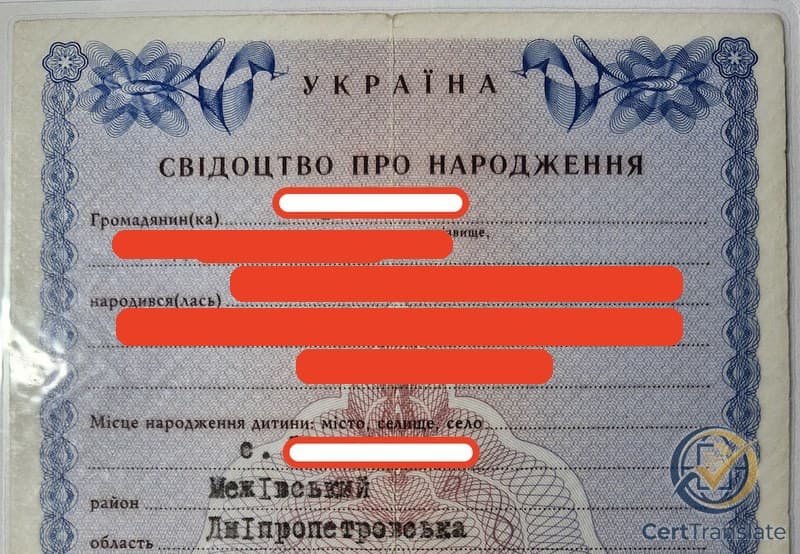
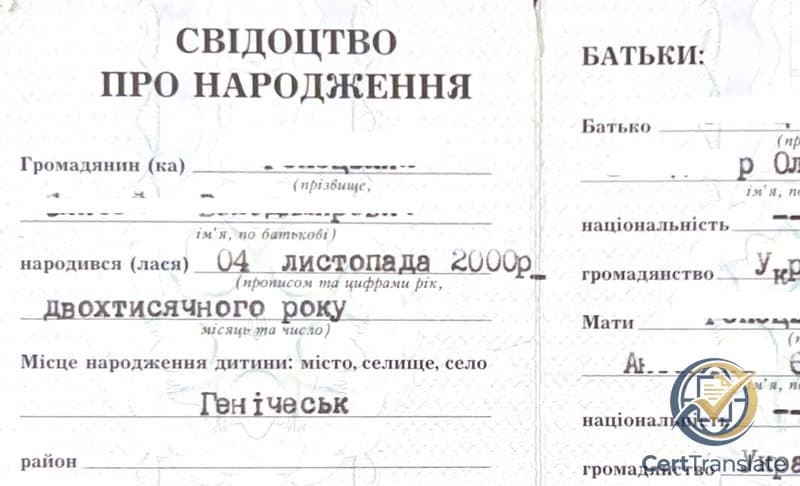
A modern Ukrainian birth certificate (post-1991) contains the following fields. Each one must be included in the certified translation — omitting any field makes the translation incomplete under USCIS standards.
Прізвище (Surname / Family Name): The child's family name. In Ukrainian naming, this is the inherited surname from the father (or mother, depending on registration). Example: Шевченко → Shevchenko. The surname field is the first component of the three-part name.
Ім'я (Given Name / First Name): The child's given name. Ukrainian given names may have diminutive forms used in daily life, but the birth certificate records the full formal name. Example: Олександр (not Сашко or Саша). The translator uses the formal name as written.
По батькові (Patronymic): The name derived from the father's first name. For males, it ends in -ович or -ійович. For females, it ends in -івна or -ївна. Example: if the father is Олександр, a son's patronymic is Олександрович, a daughter's is Олександрівна. This is a legal name component in Ukraine — it appears on passports, IDs, and all official documents. It is NOT optional in translation.
Дата народження (Date of Birth): The date in day-month-year format (common in Ukrainian documents), for example "15 березня 1990 року" (15 March 1990). The translator converts the month name from Ukrainian to English and usually reformats to the receiving authority's expected format.
Місце народження (Place of Birth): The city, town, or village and oblast (region) where the child was born. Examples: "м. Київ" (city of Kyiv), "с. Вишневе, Київська область" (village of Vyshneve, Kyiv Oblast). City and region names must be transliterated consistently with other documents in the packet.
Відомості про батьків (Parents' Information): Full names of both parents — each with прізвище, ім'я, по батькові. The mother's maiden name may appear separately or may be the same as her current surname depending on whether she changed her name at marriage. Both parents' patronymics must be included.
Громадянство батьків (Parents' Citizenship): Often listed as "громадянин/громадянка України" (citizen of Ukraine). For cases involving mixed citizenship, this field becomes especially relevant.
Національність (Nationality/Ethnicity): This field appeared on Soviet-era certificates and some early post-independence documents. It recorded ethnic nationality (українець/українка, росіянин, etc.), not citizenship. On modern certificates, this field is often omitted or optional. If present, it must be translated.
Найменування органу РАЦС (Registry Office Name): The full name of the РАЦС office that registered the birth. Example: "Шевченківський районний відділ РАЦС м. Києва" (Shevchenkivskyi District РАЦС Office, City of Kyiv). This field establishes the document's issuing authority and must be translated completely, including district and city information.
Номер актового запису (Act Record Number): A numerical identifier in the registry's records — for example, "Актовий запис № 1547." This number ties the certificate to the original entry in the registry book. It is reproduced exactly in the translation, not translated or reformatted.
Дата видачі (Date of Issuance): When the certificate was issued. This may differ from the date of birth if the certificate was issued later (common for replacement certificates). The translator notes the distinction if it could cause confusion.
Печатка та підпис (Seal and Signature): The official seal of the РАЦС and the signature of the registrar. The translator describes the seal text and notes the signature presence — both are required for the translation to be considered complete.
Typical field layout on a post-1991 certificate
Прізвище: Коваленко · Ім'я: Марія · По батькові: Олександрівна · Дата народження: 23 квітня 1995 р. · Місце народження: м. Львів, Львівська область · Батько: Коваленко Олександр Іванович · Мати: Коваленко (Петренко) Наталія Сергіївна · РАЦС: Галицький районний відділ РАЦС м. Львова · Актовий запис № 892
Modern vs Soviet-Era Format
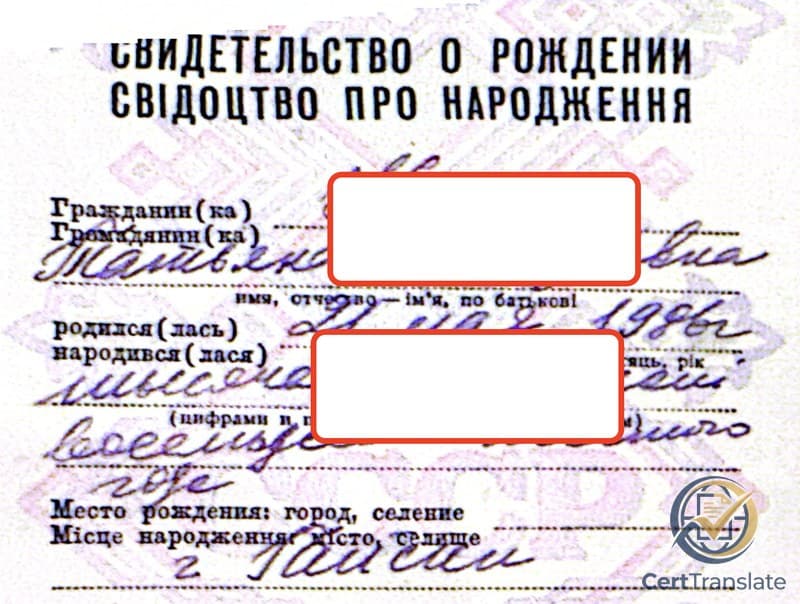
If you have a Ukrainian birth certificate issued before 1991, it was produced under the Soviet civil registry system (ЗАГС — Запис Актів Громадянського Стану, the Soviet equivalent of РАЦС). These documents look different from modern certificates and require different handling during translation.
Language: Soviet-era certificates from Ukraine were typically bilingual — printed in both Russian and Ukrainian on a standardized USSR template. The column headers, field labels, and pre-printed text appeared in both languages side by side. The handwritten or typed entries might be in Russian only, Ukrainian only, or a mix. The translator must translate ALL content, including both language versions of pre-printed text, and note which language was used for the filled-in entries.
Template: The Soviet template used a two-column layout (Russian on the left, Ukrainian on the right) with the coat of arms of the Ukrainian SSR at the top. Modern certificates use a single-language Ukrainian layout with the trident (тризуб) coat of arms and a blue or green security background with watermarks.
Issuing authority: Soviet certificates show the ЗАГС office name, which may include district (район) and city references that no longer exist or have been renamed since independence. The translator uses the name as written on the document and may add a note if the modern equivalent is relevant for context.
Nationality/ethnicity field: Soviet certificates prominently included "Національність" (nationality in the ethnic sense). This was a mandatory field under Soviet law. Modern Ukrainian certificates either omit it or make it optional. If present, the translator includes it faithfully.
Both formats are legally valid. Ukrainian law recognizes Soviet-era civil registry documents as legitimate records. USCIS similarly accepts them with a proper certified translation. The key difference for translation is knowing which template you are working with so the field labels and structure are rendered accurately. For a deeper look at Soviet-era document challenges, see our Soviet-era document translation guide.
Transliteration and Passport Alignment
One of the trickiest aspects of Ukrainian birth certificate translation is transliteration — converting Cyrillic text into Latin characters. Ukrainian transliteration has specific rules that differ from Russian transliteration, and getting this wrong can cause serious problems in immigration and legal filings.
Ukraine adopted an official transliteration system (based on the Ukrainian National romanization standard) that is used on modern Ukrainian passports. This system governs how names and place names are rendered in Latin characters. Key examples: Київ → Kyiv (not Kiev), Харків → Kharkiv (not Kharkov), Олександр → Oleksandr (not Aleksandr), Євгенія → Yevheniia (not Evgeniya). These distinctions matter because USCIS cross-references names across documents — if the birth certificate translation says "Aleksandr" but the passport says "Oleksandr," it creates an inconsistency.
The translator's approach: the certified translation renders the name as it appears on the source document (the birth certificate) and aligns the English spelling with the applicant's Ukrainian passport wherever possible. If the passport uses a different transliteration from what the birth certificate would produce under the official system, the translator notes the discrepancy. This typically happens with older passports that used Soviet-era transliteration conventions.
Ukrainian-specific characters that are commonly mistransliterated: Ї → Yi (not I), І → I (not И), Є → Ye (not E), Ґ → G (not H). These characters do not exist in Russian Cyrillic, and a translator who treats Ukrainian text as Russian will produce incorrect transliterations. This is one of the main reasons Ukrainian documents should be translated by a Ukrainian-language specialist, not a generic "Cyrillic" translator.
Place name transliteration follows the same rules. After 2019, Ukraine's official position is to use Ukrainian-based transliteration for all geographic names (Kyiv, Lviv, Kharkiv, Odesa, Dnipro). If an older document uses Russian-based spellings (Kiev, Lvov, Kharkov, Odessa, Dnepropetrovsk), the translator uses the name as written on the source document and may note the current official equivalent.
How Translators Handle This Document
Here is the standard workflow an experienced translator follows when translating a Ukrainian birth certificate for official use.
Step 1 — Identify the document era: Is this a post-1991 Ukrainian-language certificate or a Soviet-era bilingual certificate? The answer determines the template, the expected field structure, and the issuing-authority terminology.
Step 2 — Translate every field: All fields described above are rendered in English. Nothing is omitted — not the patronymic, not the act record number, not the registry office name. If the document has marginal notes, amendments, or corrections added by the registry office (виправлення), those are included too.
Step 3 — Handle the seal: Ukrainian birth certificates carry an official seal (печатка) from the РАЦС. The text within the seal is translated, and the presence of the seal is noted in the translation. If the seal is partially illegible (common on older documents), the translator notes what is readable and flags what is not.
Step 4 — Align transliteration with passport: The translator checks the applicant's passport (if available) to ensure names and place names are spelled consistently between the birth certificate translation and the passport. If there is a discrepancy, a translator's note explains it.
Step 5 — Cross-reference with other documents: If the birth certificate is part of a larger packet (marriage certificate, diploma, etc.), the translator verifies that names, dates, and patronymics are consistent across all translations. Inconsistencies are flagged with explanatory notes.
Step 6 — Certificate of Accuracy: The translator attaches a signed Certificate of Accuracy certifying that the translation is complete and accurate — this is the document USCIS requires per 8 CFR 103.2(b)(3). For more on what this certificate contains and why it matters, see our USCIS translation requirements guide.