What "Soviet-Era Document" Means
In translation context, a "Soviet-era document" is any official record issued before August 24, 1991 (the date of Ukrainian independence) within the territory of the Ukrainian Soviet Socialist Republic (Ukrainian SSR). This includes birth certificates, marriage certificates, divorce decrees, death certificates, diplomas, military service records, employment workbooks (трудова книжка), police clearance records, and court documents.
The significance for translation is not just the date. Soviet-era documents were produced under a different administrative system, used different templates, had different institutional names, and — critically — were often bilingual in ways that modern Ukrainian documents are not. A translator who treats a Soviet-era Ukrainian birth certificate the same way as a modern one will miss important context and may produce an incomplete or misleading translation.
The "transitional period" (approximately 1991–1994) deserves special mention. During these years, newly independent Ukraine was still using Soviet-era templates, Soviet-era institutional names, and Soviet-era procedural frameworks while gradually transitioning to Ukrainian-only formats and the new РАЦС system. Documents from this period may look Soviet but were issued by a nominally independent Ukrainian registry. The translator handles them the same way as Soviet-era documents — translating what is on the document, not what it "should" look like under a different system.
The ЗАГС Civil Registry System
ЗАГС (Запис Актів Громадянського Стану in Ukrainian, Запись Актов Гражданского Состояния in Russian) was the Soviet civil registry system. It handled the registration of all civil status events: births, marriages, divorces, deaths, name changes, and adoptions. Every city, district, and in some cases village had a ЗАГС office.
ЗАГС was a secular, state-run system. Under Soviet law, only ЗАГС registrations had legal force — church baptisms, religious marriages, and other religious ceremonies had no legal status. This means that the ЗАГС-issued document IS the legal record, regardless of any religious ceremonies that may have also taken place.
After Ukrainian independence, the ЗАГС system was replaced by РАЦС (Реєстрація Актів Цивільного Стану), later reorganized as ДРАЦС under the Ministry of Justice. The physical records — the bound registry books (актові записи) where every birth, marriage, and death was recorded in ink — were inherited by the successor ДРАЦС offices. This means the records are continuous: a person born in 1980 has their birth recorded in a ЗАГС book that now sits in a ДРАЦС office.
For the translator, the key implication is that a document showing "ЗАГС" as the issuing authority tells them they are working with a Soviet-era template and should expect bilingual content, Soviet-era administrative terminology, and potentially different formatting from modern РАЦС documents. A document showing "РАЦС" or "ДРАЦС" tells them the document was issued (or reissued) after independence and follows the modern Ukrainian format.
Bilingual Document Formats
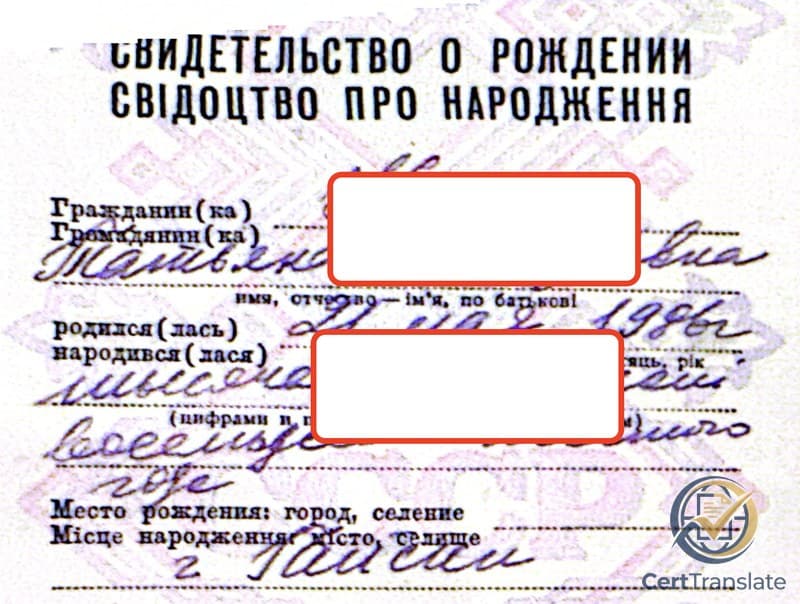
Soviet-era documents from the Ukrainian SSR were almost always bilingual: Russian and Ukrainian. This was a legal requirement under Soviet nationality policy, which mandated that official documents in the union republics appear in both the local language and Russian (the lingua franca of the USSR).
The typical layout was a two-column or two-section format. Russian text appeared on the left (or at the top), and Ukrainian text appeared on the right (or at the bottom). The pre-printed field labels ("Фамилия / Прізвище", "Имя / Ім'я", "Отчество / По батькові") were printed in both languages. The filled-in content (the actual names, dates, and places) was typically handwritten or typed in ONE language — sometimes Russian, sometimes Ukrainian, sometimes a mix.
This creates three categories of content the translator must handle: (1) Pre-printed template text in both Russian and Ukrainian — both must be translated. (2) Handwritten or typed entries in one language — the translator identifies which language and translates from that language. (3) Official stamps and seals, which may contain text in Russian, Ukrainian, or both — all seal text must be translated.
A critical subtlety: the Russian and Ukrainian pre-printed labels are NOT always exact translations of each other. The Soviet templates were standardized, but minor differences in phrasing between the Russian and Ukrainian columns did exist. The translator must translate what is actually written, not assume the two columns say the same thing.
Mixed-Language Content
One of the most challenging aspects of Soviet-era document translation is mixed-language content — documents where the filled-in entries use BOTH Russian and Ukrainian in different fields, or even within the same field.
How this happens: the registrar filling in the document might write the person's name in Ukrainian (because that is how the family identified the name) but write the place of birth in Russian (because that was the official administrative convention). Or the name might appear in its Russian form ("Александр" instead of Ukrainian "Олександр"), even though the person's family used the Ukrainian form, simply because the registrar defaulted to Russian.
For translation, the translator must: (1) Identify which language each entry is written in. This requires fluency in BOTH Russian and Ukrainian — a translator who knows only one language will make errors. (2) Translate each entry from its actual language, not from the assumed language. (3) Note the language of each entry if it affects interpretation. For example, if the name appears in Russian form, the translator notes this so the reader understands why the transliteration might differ from a Ukrainian-language passport.
Patronymic differences are the most common mixed-language issue. A birth certificate might show the Russian patronymic form "Александровна" while the same person's modern Ukrainian passport shows the Ukrainian form "Олександрівна". These are the same patronymic in two languages. The translator explains this equivalence in a translator's note. For more on how the patronymic system works, see our Ukrainian patronymic guide.
Given name differences follow the same pattern: Сергей (Russian) = Сергій (Ukrainian), Евгения (Russian) = Євгенія (Ukrainian), Фёдор (Russian) = Федір (Ukrainian). Each of these produces a different transliteration in English. Knowing which language the name was written in is essential for producing the correct English rendering.
Renamed Cities and Institutions
Soviet-era documents contain city names, district names, and institutional names that may no longer exist on modern maps. Ukraine has undergone multiple waves of renaming — after independence in 1991, during administrative reforms, and most extensively during the 2015 decommunization laws (закони про декомунізацію). For translation, this means many place names on the source document will not match current geography.
Major city renames: Днепропетровськ (Dnepropetrovsk) → Дніпро (Dnipro). Кіровоград (Kirovohrad) → Кропивницький (Kropyvnytskyi). Жданов (Zhdanov) → Маріуполь (Mariupol). Ворошиловград (Voroshilovgrad) → Луганськ (Luhansk). Коммунарськ (Kommunarsk) → Алчевськ (Alchevsk). These are the most well-known, but hundreds of smaller cities, towns, and streets were also renamed.
Institutional renames: Soviet-era universities and institutes have been renamed, merged, or restructured. For example: Киевский политехнический институт (Kyiv Polytechnic Institute) is now КПІ ім. Ігоря Сікорського (Igor Sikorsky KPI University). Львовский государственный университет им. Ивана Франко (Lvov State University named after Ivan Franko) is now Львівський національний університет імені Івана Франка (Ivan Franko National University of Lviv).
The translator's approach: always use the name as it appears on the source document. The translator does NOT substitute the modern name for the Soviet-era name in the body of the translation — that would alter the document's content. Instead, the translator may add a note: "The city referenced as Днепропетровск on this document is now known as Dnipro." This preserves the document's integrity while giving the English reader the context they need.
For credential evaluators (WES, ECE), the institution name on the diploma must match what WES has in their database. WES typically has both the Soviet-era name and the current name on file and can cross-reference them. The translator's note connecting the two names helps the evaluator make this connection.
Soviet-Era Document Types
Different Soviet-era documents have different formats, and each presents its own translation challenges. Here are the most commonly translated types:
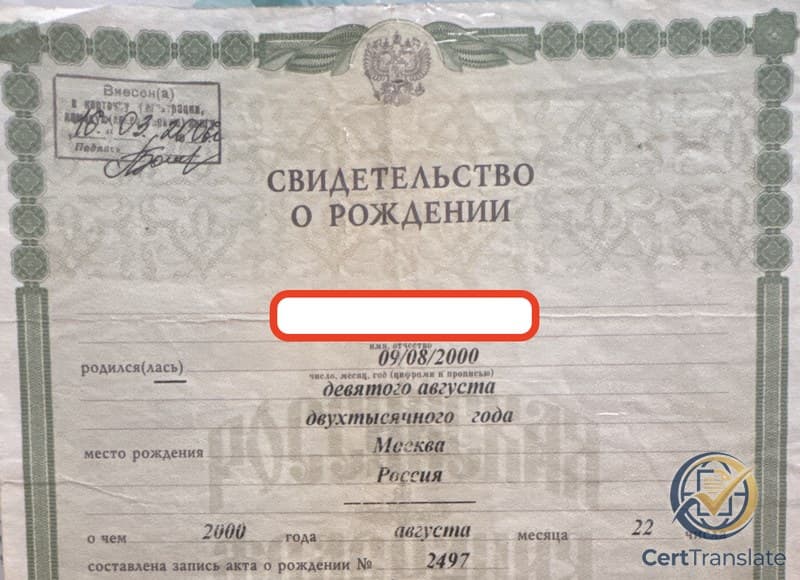
Свидетельство о рождении / Свідоцтво про народження (Birth certificate): The most frequently translated Soviet-era document. Bilingual format with the Ukrainian SSR coat of arms on top. Contains the same core fields as a modern certificate (name, parents, date/place of birth) plus the mandatory "национальность" (ethnic nationality) field. For a detailed field-by-field breakdown, see our Ukrainian birth certificate guide.
Свидетельство о браке / Свідоцтво про шлюб (Marriage certificate): Bilingual format with both spouses' full names (including patronymics), dates of birth, and the ЗАГС office that performed the registration. Soviet marriage certificates often include the spouses' places of work (место работы / місце роботи) — a field that does not appear on modern certificates but must be translated if present.
Диплом (Diploma): Soviet-era diplomas were issued on standardized templates — dark blue hardcover booklets with gold lettering. The diploma text was typically in Russian only (even in Ukraine), with the academic supplement (вкладиш) in Russian. This means the translator works from Russian only, not from bilingual text. The degree designation was almost always "специалист" (specialist). For more on how Soviet-era academic documents translate, see our Ukrainian diploma translation guide.
Трудовая книжка / Трудова книжка (Labor book / Employment record): A comprehensive employment history maintained by the employer and transferred when the worker changed jobs. This was the Soviet and post-Soviet equivalent of a combined employment history and social security record. It contains every employer's name, job title, dates of employment, and reasons for leaving. Translating a labor book is typically a multi-page project because it spans an entire career.
Справка о несудимости / Довідка про несудимість (Police clearance certificate): A document confirming the absence of a criminal record. Soviet-era versions were issued by the Ministry of Internal Affairs (МВД). The format was typically a single page with a seal and signature. Translating older versions may involve reading handwritten entries in Russian cursive — one of the most challenging tasks in Soviet-era document translation.
Военный билет / Військовий квиток (Military ID / Military service record): A booklet documenting military service. Soviet-era military records contain rank, unit, service dates, awards, and medical classification. These documents use specialized military terminology that may not appear in standard dictionaries and require specific subject-matter expertise.
Legal Validity and USCIS Acceptance
A common concern among applicants is whether a Soviet-era document is still "valid." The answer is unambiguously yes. Ukrainian law provides for legal continuity of civil registry records: documents issued by ЗАГС under Soviet law are recognized by the current Ukrainian legal system as valid civil status records. A person born in 1975 in the Ukrainian SSR does not need to obtain a new birth certificate from ДРАЦС — the original ЗАГС-issued certificate is sufficient.
USCIS similarly accepts Soviet-era documents. The USCIS Policy Manual does not distinguish between Soviet-era and post-independence documents from the same territory. What USCIS requires is a complete, accurate certified translation per 8 CFR 103.2(b)(3). The age or era of the document is irrelevant as long as it is a legitimate government-issued record.
That said, Soviet-era documents may trigger additional scrutiny in certain situations: if the document is physically damaged, faded, or partially illegible, USCIS may request a clearer copy or a replacement. If the applicant's name appears differently on the Soviet-era document vs. their current passport (due to Ukrainian vs. Russian language forms), the translator's note explaining the language difference is essential context. If the document shows a city name that no longer exists, the translator's note identifying the current name helps the adjudicator verify the information.
Optional: replacement documents. If an applicant prefers a modern Ukrainian-format document, they can request one from the ДРАЦС office that inherited the original ЗАГС records. The replacement (повторне свідоцтво) will be issued in modern Ukrainian format with the current trident coat of arms. This is entirely optional — no authority requires it. But some applicants prefer it because it simplifies the translation and avoids the bilingual complexity of the Soviet-era format.
Archival Challenges and Replacements
Obtaining copies of Soviet-era documents — or verifying information from the original registry books — can be challenging for several reasons:
Location of records: Soviet-era ЗАГС records are held by the successor ДРАЦС offices at the location where the event was registered. If you were born in a village in Donetsk Oblast, the records are in the ДРАЦС office that covers that village — which may now be in an occupied or conflict-affected area. If the records are inaccessible, the applicant may need to work with centralized Ukrainian government services to obtain replacements.
Physical condition of records: Soviet-era registry books were handwritten in ink in bound ledgers. After 30–60+ years, some entries may be faded, smudged, or damaged by water or fire. If the original book entry is illegible, the ДРАЦС office may issue a replacement certificate based on whatever information is readable, supplemented by secondary sources. The translator translates the document as issued, noting any illegible portions.
Destroyed or lost records: In some cases, the original registry books were destroyed — during World War II, during the post-independence transition, or in the current conflict. If no record exists, the applicant may need to go through a court process to establish the fact (встановлення факту) and obtain a court-ordered replacement document. For USCIS submissions where the original document is genuinely unavailable, the secondary evidence provisions of 8 CFR 103.2(b)(2) apply.
Digital records: Ukraine has been digitizing civil registry records through the Дія platform and centralized ДРАЦС databases. For many (but not all) Soviet-era records, digital copies now exist in the central system. This makes obtaining replacements faster than it used to be, even when the original physical records are in a different location. The availability of digital records varies by region and time period.
How Translators Identify and Handle Soviet-Era Documents
An experienced translator identifies a Soviet-era document within seconds by checking for these markers:
Visual markers: (1) The coat of arms: the Ukrainian SSR emblem (hammer, sickle, wheat, and red star) vs. the modern Ukrainian trident (тризуб). (2) The template layout: bilingual two-column format vs. single-language modern format. (3) The paper: older, thicker paper without security features vs. modern security-printed documents with watermarks and holograms. (4) Handwriting vs. printing: Soviet-era documents were often handwritten in cursive; modern documents are typically computer-printed.
Textual markers: (1) The issuing authority: ЗАГС vs. РАЦС/ДРАЦС. (2) The administrative terminology: "Украинская Советская Социалистическая Республика" (Ukrainian Soviet Socialist Republic) vs. "Україна" (Ukraine). (3) The nationality field: "национальность" (ethnic nationality), which was mandatory on Soviet documents and optional or absent on modern ones. (4) The date: any date before August 24, 1991, combined with the other markers, confirms a Soviet-era document.
Once the era is identified, the translator applies this workflow: (1) Determine the primary and secondary languages on the document. (2) Translate ALL content from both languages. (3) Identify which language the handwritten entries are in and translate from that language. (4) Preserve all original terms in the translation (e.g., "ЗАГС" is rendered as "ZAGS (Registry of Civil Status Acts)" on first mention). (5) Add a translator's note identifying the document as Soviet-era, explaining the bilingual format, and noting any renamed cities or institutions. (6) Cross-reference names with other documents in the packet to ensure consistency across eras and languages.
The overarching principle: the translator serves the document, not a preferred narrative. If the document says "Днепропетровск," the translation says "Dnepropetrovsk," not "Dnipro" — with a note providing the current name. If the name is in Russian form, the translation reflects the Russian form — with a note explaining the Ukrainian equivalent. This is what fidelity to the source document means, and it is what USCIS, courts, and evaluators expect.