




Why does a Cuban birth certificate list grandparents with only first names?
TL;DRA Cuban certificación de nacimiento (birth certificate) recorded the child's paternal and maternal grandparents by given name only — no surnames attached in either field — which is standard Cuban Civil Registry practice but reads as an omission to U.S. adjudicators used to Mexican or Colombian records. We transcribed the fields exactly as written and added a Translator's Note documenting the Cuban convention. The certified translation was delivered for a USCIS family-based immigration filing.
Case Specifications
- Document
- Birth certificate
- Foreign Name
- Certificación de Nacimiento
- Country
- Cuba
- Languages
- Spanish → English
- Submitted To
- USCIS (family-based immigration filing)
What We Received
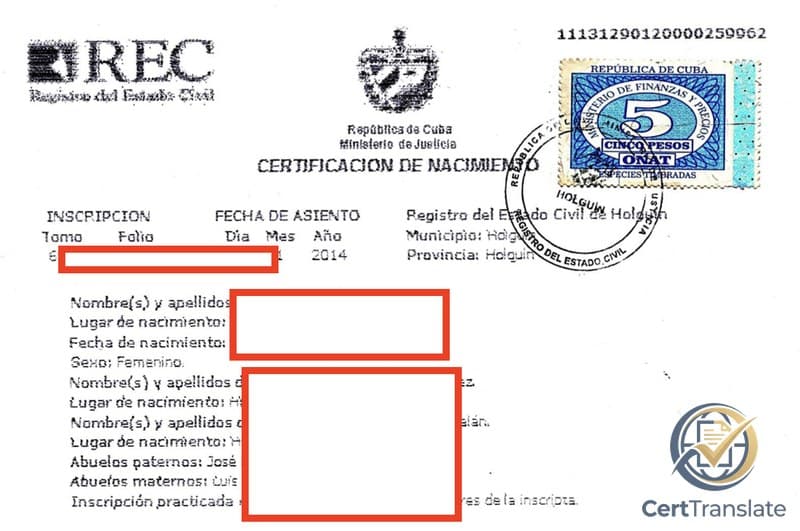
A client submitted a Cuban certificación de nacimiento issued by a provincial Civil Registry in eastern Cuba. The entry was originally inscribed in 2014 for a child born in 2013, and re-issued from Cuba's automated Civil Registry system in 2022 — Cuba has issued certifications through an automated system since July 15, 2008, which is printed as a standing notice on every modern copy.
The record listed the child's full name and sex, both parents' full names with two surnames each (paternal + maternal, Spanish-style), and two separate grandparent fields — "Abuelos paternos" and "Abuelos maternos." In both fields the entry was "[given name] y [given name]": the two paternal grandparents by first name only, and the two maternal grandparents by first name only. No paternal or maternal surname appeared anywhere in either grandparent field.
The certified birth certificate translation was needed for a USCIS family-based filing and benefits from the same Spanish translation services workflow we use for other Caribbean and Latin American civil-registry documents.
Why This Required Special Handling
Spanish-speaking civil registries across Latin America are not uniform. A Mexican acta de nacimiento, a Colombian registro civil, and a Puerto Rican certificado de nacimiento all record grandparents with the same two-surname convention used for the parents. A USCIS officer, a consular adjudicator, or a credential evaluator reading dozens of Spanish-language birth records a week sees that full-name grandparent block as the default.
The Cuban Civil Registry does it differently. Historically — and on the automated forms issued since the 2008 reform — the abuelos paternos and abuelos maternos fields record grandparents by given name only, joined by "y" ("and"). The surnames are deliberately omitted at the registry level. A translator who transcribes the field faithfully ends up with "Paternal grandparents: [given name] and [given name]" — factually correct, but visually identical to what a careless translation of a Mexican record would look like if the surnames had been dropped.
In lineage-heavy filings — an I-130 family petition establishing the parent-child relationship, a derivative-citizenship case, or an adjustment packet under the Cuban Adjustment Act — an adjudicator who notices missing grandparent surnames can read that as a translation error and issue a Request for Evidence. This is consistent with the broader pattern documented in our USCIS translation requirements overview, where any visible inconsistency between the original and the translation is treated as a question to be answered.
The translator cannot invent surnames that the original does not contain. The only professional option is to preserve the Cuban record exactly as issued and tell the reader, inside the certification, that what looks like an omission is in fact how the Cuban Civil Registry writes these fields.
How We Handled It
We transcribed each grandparent field exactly as it appeared on the Cuban original — two given names joined by "and," with no surname information added, inferred, or guessed at — and added a Translator's Note in the certification block at the end of the document explaining the Cuban Civil Registry convention.
"The Cuban Civil Registry records grandparents by given name only in the "Abuelos paternos" and "Abuelos maternos" fields (e.g., "Abuelos paternos: [given name] y [given name]"). No paternal or maternal surname appears in the original for the grandparent entries, and none has been added in the translation. This is standard Cuban Civil Registry practice and is not an omission by the translator."

The rest of the certification had a second layer of Cuba-specific features that also had to be preserved faithfully rather than flattened into generic English. We transcribed the ONAT fiscal revenue stamp ("Especies Timbradas") applied in the upper right corner of the form — Cuba requires civil-registry certifications to carry a tax-paid stamp at issuance, and the stamp must be described, not silently dropped, so the English reader understands that the document is a tax-paid official issue. The standing notice that the Civil Registry of that province "issues certifications under an automated system beginning July 15, 2008" was carried over verbatim, since it explains why a 2014 inscription prints on a 2022-dated form.
We also preserved the dual-signer structure typical of Cuban civil-registry outputs: the form separately names a "Confrontado por" (verifier) and a "Hecho por" (preparer), while the final signed authority is the "Registrador(a) del Registro del Estado Civil" who seals the document. Each role was translated with its Cuban title and function intact — "Verified by," "Prepared by," and "Registrar of the Civil Registry" — rather than collapsed into a single undifferentiated signature line. The circular official seal of the Ministry of Justice overlapping the Registrar's signature was described in brackets with its visible text reproduced in translation.
The Outcome
The certified translation was delivered to the client for inclusion in the USCIS family-based petition packet. The Translator's Note on the grandparents convention gives the adjudicator the context needed to read the Cuban record on its own terms, instead of comparing it against the Mexican or Colombian templates a U.S. officer sees most often.
The same note language, adapted only for document-specific field names, now travels with every Cuban certificación de nacimiento we translate — so Cuban lineage records no longer trigger "where are the grandparents' surnames?" back-and-forth between the client, their attorney, and us.
What This Means for You
A certified translation of a Cuban birth certificate must preserve the Cuban Civil Registry's first-name-only convention for grandparents, not silently invent surnames to make the record look like a Mexican or Colombian birth certificate. A Translator's Note that explicitly describes the Cuban convention gives a U.S. adjudicator the context to evaluate the translation without treating the missing surnames as a translator's error.
If your Cuban certificación de nacimiento looks incomplete compared with other Spanish-language birth records your filing includes, the gap is almost certainly a Cuban registry convention, not a translation gap — and the correct fix is a note explaining the convention, not a new translation.
Have a similar situation?
We handle Cuban certificaciones de nacimiento and other Caribbean civil-registry documents regularly.
Related Cases & Resources
Sources & References
- I-130, Petition for Alien Relative·USCIS·Verified 2026-05-30
Explore the Hub
Documents
Languages
Immigration
Accepted By
All identifying information has been removed from document images. Personal names, dates, and document numbers have been masked. Case details are shared with client permission. No personal data is stored or displayed on this page.