




How do you translate an Angolan school transcript when the school issues a separate grade declaration for each year and every grade is printed twice on the 0–20 scale?
TL;DRAn Angolan polytechnic issued a vocational transcript as three per-year 'Declaração de Estudo' grade declarations instead of one consolidated transcript, with every grade printed twice on the 0–20 scale (digit + Portuguese word). We delivered one bundled certified translation with all three per-year declarations as separate pages, rendered each grade in both forms ('16 (Sixteen)'), kept 'Turma: Única' as the section name, and added Translator's Notes documenting the per-year format and that no GPA conversion was applied.
Case Specifications
- Document
- School transcript (per-year grade declarations)
- Foreign Name
- Declaração de Estudo
- Country
- Angola
- Languages
- Portuguese (Angolan) → English
- Submitted To
- U.S. credential evaluation (WES / ECE) and U.S. immigration filings (USCIS)
What We Received
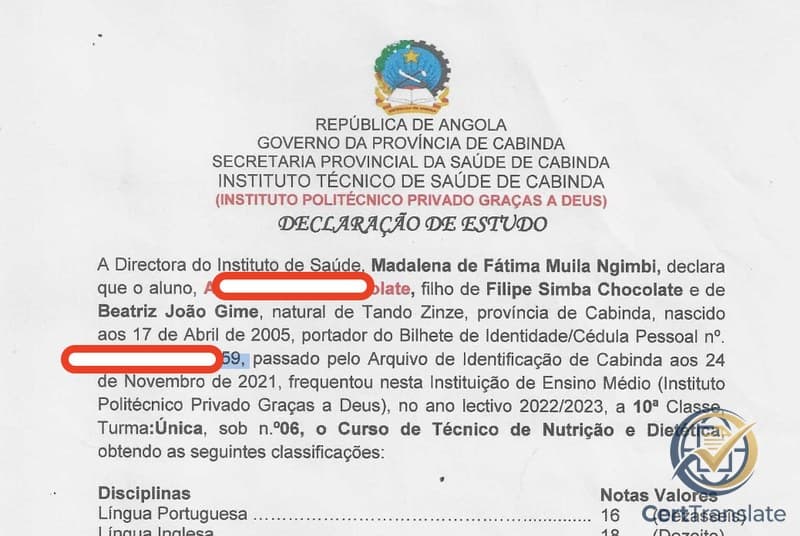
A client submitted three Angolan 'Declaração de Estudo' (Study Declaration) pages issued by the Instituto Politécnico Privado Graças a Deus, operating under the Cabinda Technical Health Institute of the Cabinda Provincial Health Secretariat, Government of Cabinda Province. Each page covered one academic year of a Técnico de Nutrição e Dietética program — 2022/2023 (10ª Classe), 2023/2024 (11ª Classe), and 2024/2025 (12ª Classe) — and was a complete one-page declaration with its own letterhead, body, grade table, and signature block, not a fragment of a larger transcript.
On every page the grade table had three columns — 'Disciplinas' (subjects), 'Notas' (grade), and 'Valores' (in words) — and every grade on the Angolan 0–20 scale was printed twice, once as a digit ('16') and once spelled out in Portuguese ('Dezasseis'). The class designation read 'Turma: Única.' The certified Portuguese translation was needed for a U.S. credential evaluation and a USCIS filing.
Why This Required Special Handling
Angolan and other PALOP (Portuguese-speaking African) schools commonly issue per-year 'Declaração de Estudo' documents in addition to or instead of a consolidated transcript. A translator who silently merges three per-year declarations into one summary table loses the document boundary that the school chose, and a credential evaluator may reject the result as a re-formatted record rather than a faithful copy of the originals.
The 0–20 dual-form grade convention — digit plus Portuguese word for the same number — is not stylistic redundancy; it is the issuer's standard anti-tampering format, and the WES and ECE instructions for foreign transcripts explicitly require the grade to appear in both forms when the original does. Collapsing '16 (Dezasseis)' to '16' alone, or to a U.S. letter grade, would alter the source and pre-empt the evaluator's job.
A third trap is 'Turma: Única.' Translated literally as 'Sole Section' or 'Sole Class,' it reads as a description ('this is the only class') rather than the section identifier the school actually used. A reader looking for the section name finds none — and per USCIS translation requirements, the translation must reflect the source faithfully, including labels that double as proper names.
How We Handled It
We delivered one bundled certified translation containing all three per-year declarations as separate pages, with the same layout each — letterhead, body paragraph, grade table, closing block, signature block — so the per-year boundary the school chose remained visible. Every grade was rendered twice: the digit unchanged, and the spelled-out Portuguese number translated into its English-word equivalent in parentheses (Dezasseis → Sixteen, Quinze → Fifteen, and so on across the 0–20 range), so the dual format the original uses survives in English.
'Turma: Única' was retained verbatim — Portuguese in, Portuguese out — and a Translator's Note explained that 'Única' is the literal name of the section in this school's organisation, not a description of how many sections existed in that academic year. The school's name 'Graças a Deus' was kept as a proper noun (not translated as 'Thanks to God'), and the chain of issuing authorities (Republic of Angola → Government of Cabinda Province → Cabinda Provincial Health Secretariat → Cabinda Technical Health Institute → Graças a Deus Private Polytechnic Institute) was preserved in the letterhead in full.
The circular wet stamp on pages 2 and 3, which partially overlaps the Director's signature, was described in brackets in line with our stamps-fully-translated practice for USCIS submissions: 'CABINDA · R.A.' along the lower arc was transcribed exactly, the central coat-of-arms graphic was identified, and the obscured portions were marked partially illegible. The Director's signatures, which are stylized handwriting and not legible as a name, were marked '[Illegible signature]' under the printed name 'Madalena de Fátima Muila Ngimbi' — never with the bare '[Signature]' marker that leaves a reader unsure whether the translator could read it.
"The original record was issued as three separate one-page Declarações de Estudo, one for each academic year of the program (10ª Classe / 2022–2023, 11ª Classe / 2023–2024, 12ª Classe / 2024–2025), rather than as a single consolidated transcript. The three pages have been delivered in this translation in chronological order, with each page mirroring the layout of its source. Every grade is rendered on the original Angolan/Portuguese 0–20 scale, in the dual form used by the issuer — digit followed by the spelled-out word in parentheses (e.g., '16 (Sixteen)') — to preserve the source's anti-tampering format. No GPA, percentage, or U.S. letter-grade conversion has been applied; equivalency determinations are the credential evaluator's responsibility, not the translator's. The class designation 'Turma: Única' has been retained in Portuguese as it is the section's literal name within the school's organisation, not a description."

Two further Translator's Notes documented the standard DD de Mês de YYYY → Month DD, YYYY date conversion, and identified the partially obscured circular stamp on pages 2 and 3 as the issuing office's wet seal with only its lower-arc text and central coat-of-arms clearly visible.
The Outcome
The certified translation was delivered as a single bundle containing all three per-year Declarações de Estudo with identical layout, every grade rendered twice in the original 0–20 dual form ('16 (Sixteen)'), 'Turma: Única' retained as the section name, and the partially obscured Cabinda wet stamp on pages 2 and 3 fully described. The Translator's Notes documented the per-year format, the dual-grade convention, and the explicit non-application of any GPA or letter-grade conversion.
We apply the same approach on every Angolan and PALOP secondary-vocational record that arrives as per-year declarations rather than a consolidated transcript.
What This Means for You
An Angolan or other PALOP school transcript that arrives as separate per-year 'Declaração de Estudo' pages should be translated as one bundled certified translation that keeps each year as its own page — never collapsed into a single re-formatted summary table. Grades on the 0–20 scale should appear in both digit and word form ('16 (Sixteen)') because the original prints them that way, and section names like 'Turma: Única' should be retained verbatim with a Translator's Note. The credential evaluator, not the translator, is the one who converts foreign grades to a U.S. equivalent.
Have a similar situation?
We translate Angolan and other PALOP (Portuguese-speaking African) academic records — secondary, vocational-secondary, and higher-education transcripts, including per-year Declarações de Estudo, on the 0–20 scale — for U.S. credential evaluators (WES, ECE, SpanTran, Josef Silny) and USCIS filings regularly.
Related Cases & Resources
Sources & References
- Meet Translation Requirements·USCIS·Verified 2026-06-07
Explore the Hub
Certified Translation
Documents
Languages
Immigration
All identifying information has been removed from document images. Case details are shared with client permission. No personal data is stored or displayed on this page.